the two molecular scenes below depict the relative concentrations of h₃o⁺ (purple) in solutions of the same…
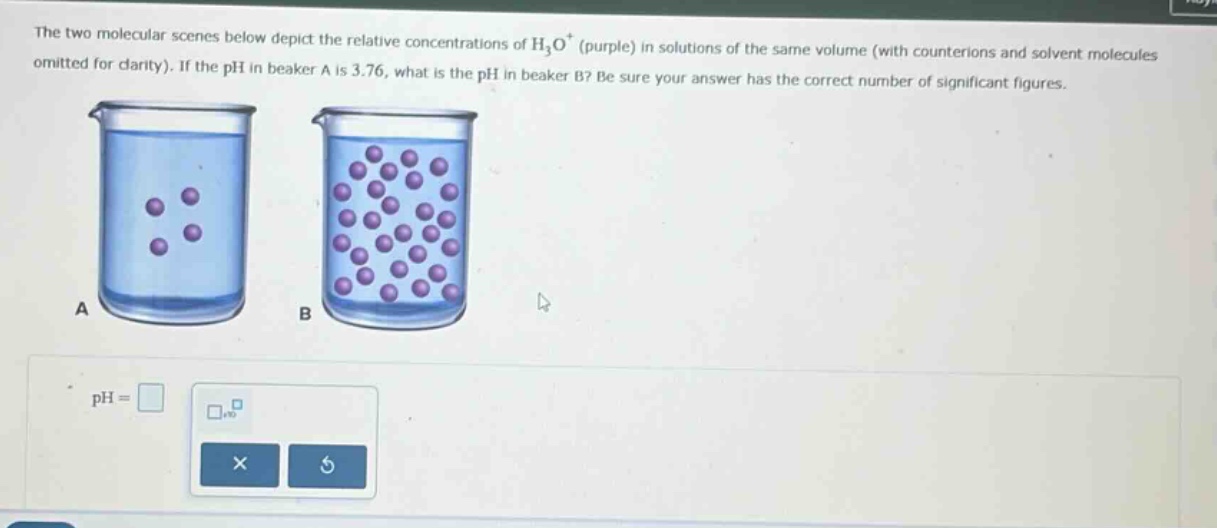
the two molecular scenes below depict the relative concentrations of h₃o⁺ (purple) in solutions of the same volume (with counterions and solvent molecules omitted for clarity). if the ph in beaker a is 3.76, what is the ph in beaker b? be sure your answer has the correct number of significant figures.
Answer
Explanation:
Step1: Calculate $[H_3O^+]$ in beaker A
The pH formula is $pH = -\log[H_3O^+]$. Given $pH_A=3.76$, we can find $[H_3O^+]_A$ as $[H_3O^+]_A = 10^{-pH_A}=10^{- 3.76}$.
Step2: Determine the ratio of $[H_3O^+]$ in beaker B to A
Count the number of $H_3O^+$ ions in beaker A and B. Assume there are 4 in beaker A and 16 in beaker B. The ratio $\frac{[H_3O^+]_B}{[H_3O^+]_A}=\frac{16}{4} = 4$. So $[H_3O^+]_B = 4\times[H_3O^+]_A=4\times10^{-3.76}$.
Step3: Calculate the pH in beaker B
Using the pH formula $pH_B=-\log[H_3O^+]_B$. Substitute $[H_3O^+]_B = 4\times10^{-3.76}$ into it. $pH_B=-\log(4\times10^{-3.76})=-\left(\log4+\log(10^{-3.76})\right)=-(0.602 - 3.76)=3.16$.
Answer:
$3.16$