two solutions of different concentrations of acid are mixed creating 40 ml of a solution that is 32% acid…
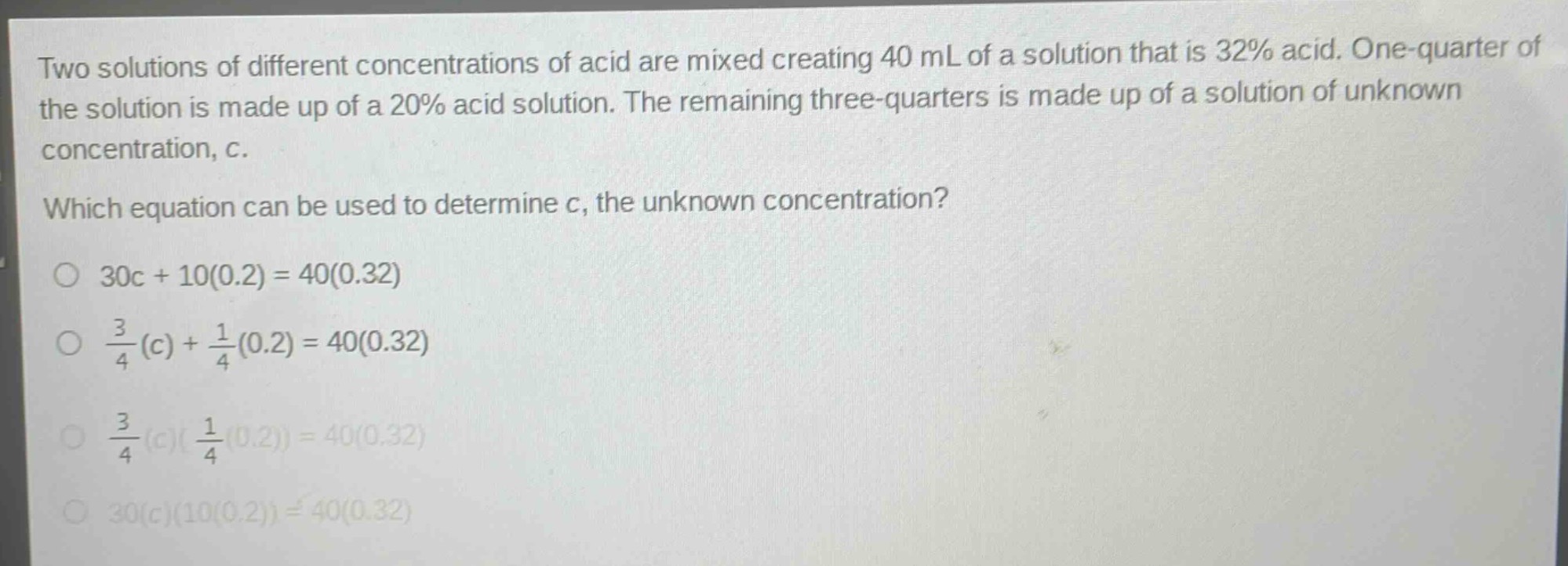
two solutions of different concentrations of acid are mixed creating 40 ml of a solution that is 32% acid. one - quarter of the solution is made up of a 20% acid solution. the remaining three - quarters is made up of a solution of unknown concentration, c. which equation can be used to determine c, the unknown concentration? o 30c + 10(0.2) = 40(0.32) o $\frac{3}{4}(c)+\frac{1}{4}(0.2)=40(0.32)$ o $\frac{3}{4}(c)(\frac{1}{4}(0.2)) = 40(0.32)$ o 30(c)(10(0.2)) = 40(0.32)
Answer
Answer:
A. $30c + 10(0.2)=40(0.32)$
Explanation:
Step1: Calculate volumes of each solution
The total volume is $40$ mL. One - quarter of $40$ mL is $\frac{1}{4}\times40 = 10$ mL (volume of 20% acid solution), and three - quarters of $40$ mL is $\frac{3}{4}\times40=30$ mL (volume of unknown - concentration solution).
Step2: Use the acid - amount formula
The amount of acid in a solution is given by the product of the volume and the concentration. The amount of acid in the 20% acid solution is $10\times0.2$. The amount of acid in the unknown - concentration solution is $30\times c$. The amount of acid in the final 32% acid solution is $40\times0.32$.
Step3: Set up the equation
By the conservation of the amount of acid (the sum of the acid amounts in the two initial solutions equals the acid amount in the final solution), we get $30c + 10(0.2)=40(0.32)$.