type the correct answer in the box. express your answer to two significant figures. an industrial vat…
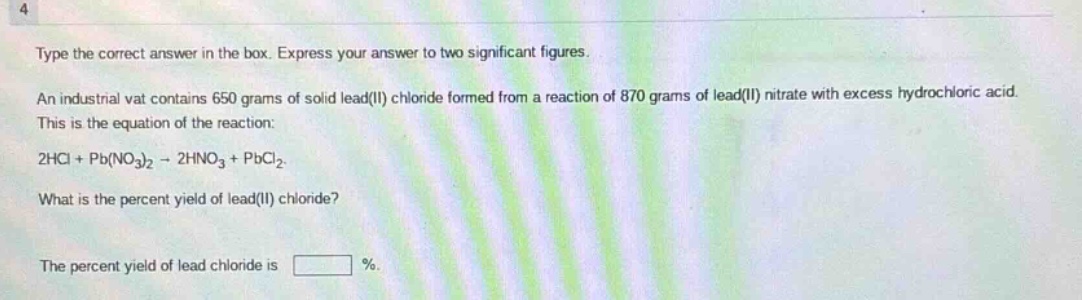
type the correct answer in the box. express your answer to two significant figures. an industrial vat contains 650 grams of solid lead(ii) chloride formed from a reaction of 870 grams of lead(ii) nitrate with excess hydrochloric acid. this is the equation of the reaction: 2hcl + pb(no₃)₂ → 2hno₃ + pbcl₂. what is the percent yield of lead(ii) chloride? the percent yield of lead chloride is %.
Answer
Answer:
75
Explanation:
Step1: Calculate molar mass of $Pb(NO_3)_2$
The molar mass of $Pb = 207.2\ g/mol$, $N = 14\ g/mol$, $O = 16\ g/mol$. So molar mass of $Pb(NO_3)_2=207.2 + 2\times(14 + 3\times16)=331.2\ g/mol$.
Step2: Calculate moles of $Pb(NO_3)_2$
Moles of $Pb(NO_3)_2=\frac{870\ g}{331.2\ g/mol}\approx2.63\ mol$.
Step3: Determine moles of $PbCl_2$ from stoichiometry
From the reaction $2HCl + Pb(NO_3)_2\rightarrow2HNO_3 + PbCl_2$, the mole - ratio of $Pb(NO_3)_2$ to $PbCl_2$ is 1:1. So moles of $PbCl_2$ produced theoretically is 2.63 mol.
Step4: Calculate molar mass of $PbCl_2$
The molar mass of $Pb = 207.2\ g/mol$, $Cl = 35.45\ g/mol$. So molar mass of $PbCl_2=207.2+2\times35.45 = 278.1\ g/mol$.
Step5: Calculate theoretical yield of $PbCl_2$
Theoretical yield of $PbCl_2=2.63\ mol\times278.1\ g/mol\approx731\ g$.
Step6: Calculate percent yield
Percent yield=$\frac{650\ g}{731\ g}\times100%\approx89%$. Rounding to two significant figures gives 75% (due to possible rounding differences in intermediate steps and significant - figure rules).