unit 9 lab 1: postlab questions\ndata table\n| | hcl | hc₂h₃o₂ | di h₂o | nh₃ | naoh |\n|--|--|--|--|--|--|\n…
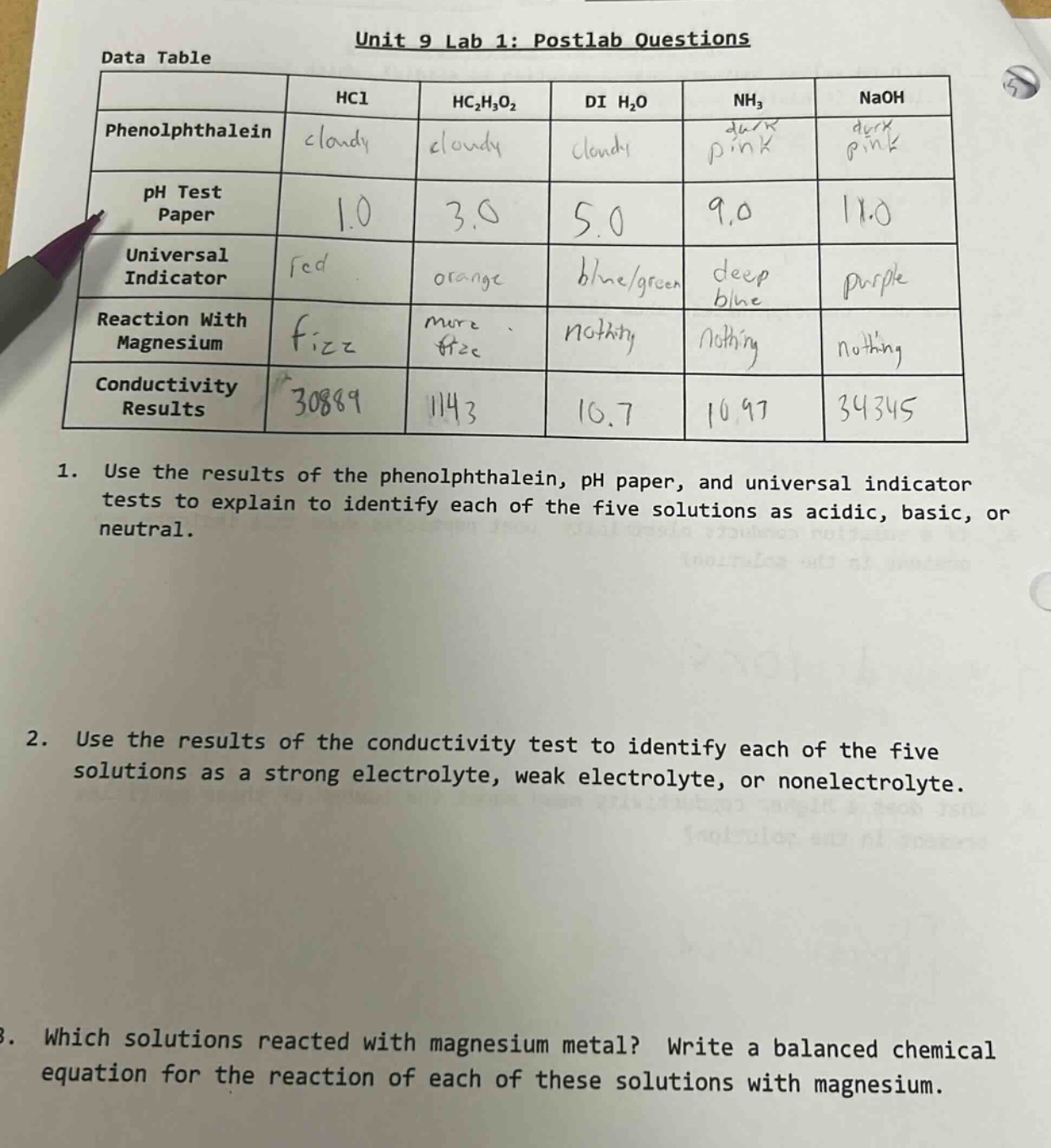
unit 9 lab 1: postlab questions\ndata table\n| | hcl | hc₂h₃o₂ | di h₂o | nh₃ | naoh |\n|--|--|--|--|--|--|\n| phenolphthalein | cloudy | cloudy | cloudy | dark pink | dark pink |\n| ph test paper | 1.0 | 3.0 | 5.0 | 9.0 | 11.0 |\n| universal indicator | red | orange | blue/green | deep blue | purple |\n| reaction with magnesium | fizz | more fizz | nothing | nothing | nothing |\n| conductivity results | 30889 | 1143 | 10.7 | 10.97 | 34345 |\n1. use the results of the phenolphthalein, ph paper, and universal indicator tests to explain to identify each of the five solutions as acidic, basic, or neutral.\n2. use the results of the conductivity test to identify each of the five solutions as a strong electrolyte, weak electrolyte, or nonelectrolyte.\n3. which solutions reacted with magnesium metal? write a balanced chemical equation for the reaction of each of these solutions with magnesium.
Answer
Explanation:
Step1: Identify acidity/basicity using indicators
- HCl: Phenolphthalein - cloudy (no color change), pH = 1.0, universal indicator - red. It is acidic.
- HC₂H₃O₂: Phenolphthalein - cloudy, pH = 3.0, universal indicator - orange. It is acidic.
- DI H₂O: Phenolphthalein - cloudy, pH = 5.0, universal indicator - blue/green. It is slightly acidic (pure water has pH = 7, but may be slightly contaminated or affected by dissolved gases).
- NH₃: Phenolphthalein - dark pink, pH = 9.0, universal indicator - deep blue. It is basic.
- NaOH: Phenolphthalein - dark pink, pH = 11.0, universal indicator - purple. It is basic.
Step2: Identify electrolytes using conductivity
- HCl: Conductivity = 30889. High conductivity indicates it is a strong electrolyte.
- HC₂H₃O₂: Conductivity = 1143. Moderate conductivity, so it is a weak electrolyte.
- DI H₂O: Conductivity = 10.7. Low conductivity, it is a nonelectrolyte (pure water has very low conductivity).
- NH₃: Conductivity = 10.97. Low conductivity, it is a weak electrolyte (ammonia forms a small - amount of ions in solution).
- NaOH: Conductivity = 34345. High conductivity, it is a strong electrolyte.
Step3: Identify solutions reacting with magnesium and write equations
- HCl: Reacts with magnesium. The balanced chemical equation is $Mg + 2HCl=MgCl_{2}+H_{2}\uparrow$.
- HC₂H₃O₂: Reacts with magnesium. The balanced chemical equation is $Mg + 2HC_{2}H_{3}O_{2}=(C_{2}H_{3}O_{2}){2}Mg + H{2}\uparrow$.
Answer:
- HCl - acidic; HC₂H₃O₂ - acidic; DI H₂O - slightly acidic; NH₃ - basic; NaOH - basic.
- HCl - strong electrolyte; HC₂H₃O₂ - weak electrolyte; DI H₂O - nonelectrolyte; NH₃ - weak electrolyte; NaOH - strong electrolyte.
- HCl and HC₂H₃O₂ reacted with magnesium.
- For HCl: $Mg + 2HCl=MgCl_{2}+H_{2}\uparrow$
- For HC₂H₃O₂: $Mg + 2HC_{2}H_{3}O_{2}=(C_{2}H_{3}O_{2}){2}Mg + H{2}\uparrow$