use the chemical equation to help you fill in the blanks below. hcl + naoh → nacl + h₂o 3. the reactant side…
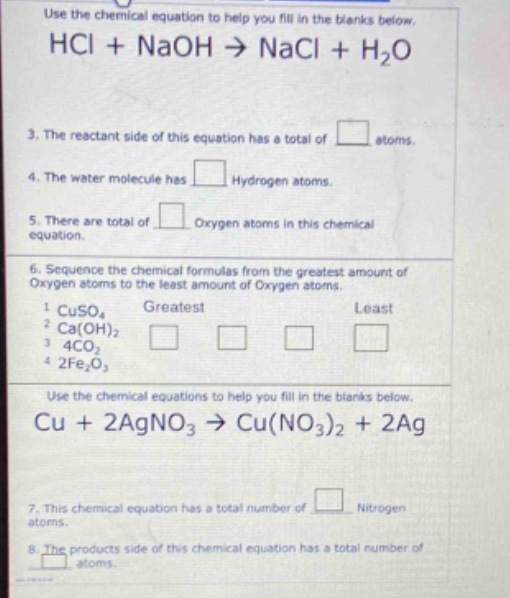
use the chemical equation to help you fill in the blanks below. hcl + naoh → nacl + h₂o 3. the reactant side of this equation has a total of atoms. 4. the water molecule has hydrogen atoms. 5. there are total of oxygen atoms in this chemical equation. 6. sequence the chemical formulas from the greatest amount of oxygen atoms to the least amount of oxygen atoms. 1 cuso₄ greatest least 2 ca(oh)₂ 3 4co₂ 4 2fe₂o₃ use the chemical equations to help you fill in the blanks below. cu + 2agno₃ → cu(no₃)₂ + 2ag 7. this chemical equation has a total number of nitrogen atoms. 8. the products side of this chemical equation has a total number of atoms.
Answer
Explanation:
Step1: Count atoms on reactant side of HCl + NaOH
HCl has 2 atoms (1 H and 1 Cl), NaOH has 3 atoms (1 Na, 1 O, 1 H). So in total, 2 + 3=5 atoms.
Step2: Analyze water molecule in HCl + NaOH reaction
The formula of water is H₂O, so it has 2 hydrogen atoms.
Step3: Count oxygen atoms in HCl + NaOH reaction
There is 1 oxygen atom in NaOH on the reactant - side and 1 oxygen atom in H₂O on the product - side, so a total of 1 + 1 = 2 oxygen atoms.
Step4: Count oxygen atoms in given compounds
- In CuSO₄, there are 4 oxygen atoms.
- In Ca(OH)₂, there are 2 oxygen atoms.
- In 4CO₂, there are 4×2 = 8 oxygen atoms.
- In 2Fe₂O₃, there are 2×3 = 6 oxygen atoms. So the order from greatest to least is 4CO₂, 2Fe₂O₃, CuSO₄, Ca(OH)₂.
Step5: Count nitrogen atoms in Cu + 2AgNO₃→Cu(NO₃)₂+2Ag
There are 2 nitrogen atoms in 2AgNO₃ on the reactant - side and 2 nitrogen atoms in Cu(NO₃)₂ on the product - side, so a total of 2 nitrogen atoms.
Step6: Count atoms on product side of Cu + 2AgNO₃→Cu(NO₃)₂+2Ag
Cu(NO₃)₂ has 1 Cu, 2 N, 6 O and 2Ag has 2 Ag. So in total, 1+2 + 6+2=11 atoms.
Answer:
- 5
- 2
- 2
- 4CO₂, 2Fe₂O₃, CuSO₄, Ca(OH)₂
- 2
- 11