use the following prompt to answer questions 6 - 10.\nin a laboratory experiment, you are tasked with…
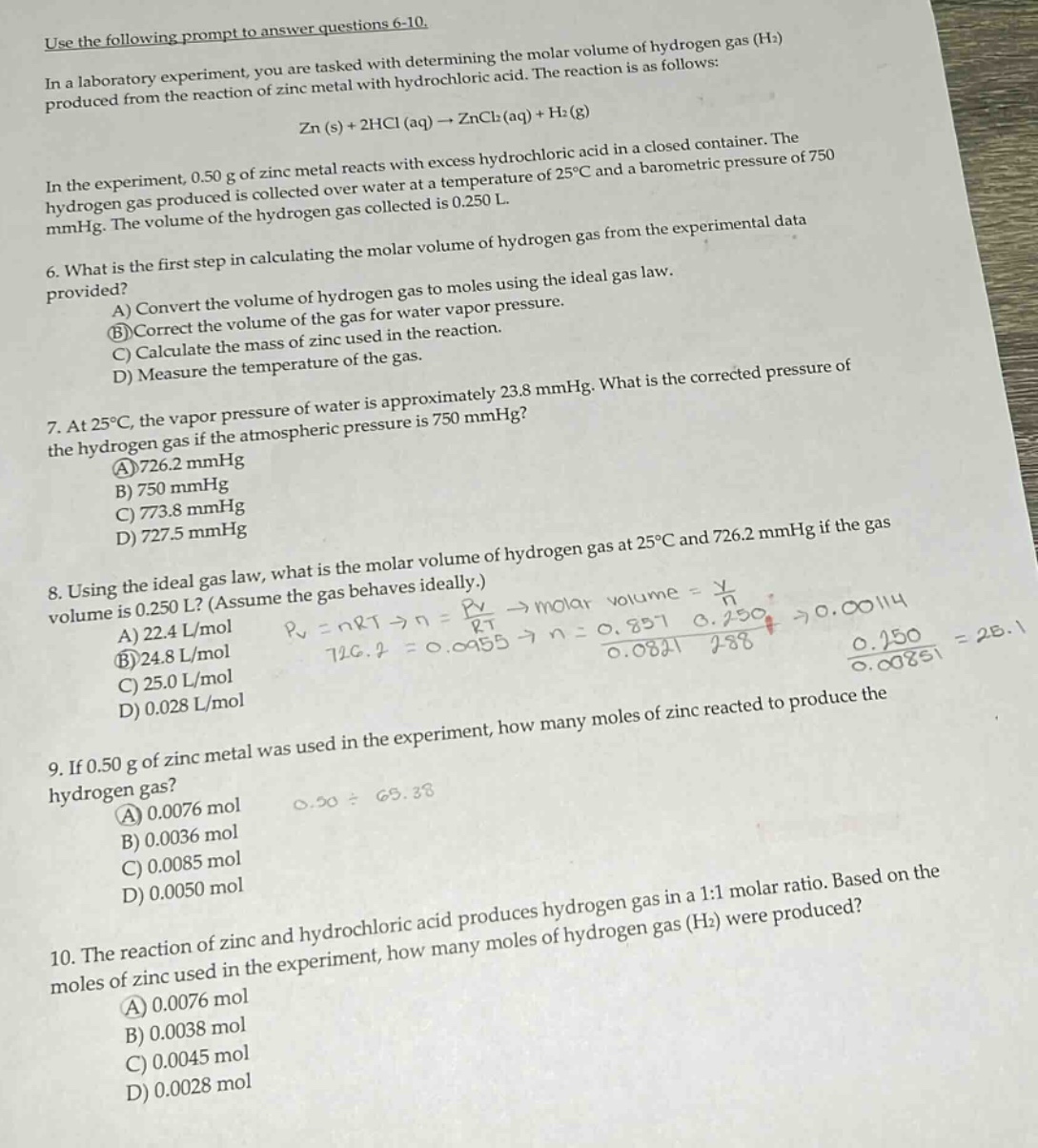
use the following prompt to answer questions 6 - 10.\nin a laboratory experiment, you are tasked with determining the molar volume of hydrogen gas (h₂) produced from the reaction of zinc metal with hydrochloric acid. the reaction is as follows:\nzn (s) + 2hcl (aq) → zncl₂(aq) + h₂(g)\nin the experiment, 0.50 g of zinc metal reacts with excess hydrochloric acid in a closed container. the hydrogen gas produced is collected over water at a temperature of 25°c and a barometric pressure of 750 mmhg. the volume of the hydrogen gas collected is 0.250 l.\n6. what is the first step in calculating the molar volume of hydrogen gas from the experimental data provided?\na) convert the volume of hydrogen gas to moles using the ideal gas law.\nb) correct the volume of the gas for water vapor pressure.\nc) calculate the mass of zinc used in the reaction.\nd) measure the temperature of the gas.\n7. at 25°c, the vapor pressure of water is approximately 23.8 mmhg. what is the corrected pressure of the hydrogen gas if the atmospheric pressure is 750 mmhg?\na) 726.2 mmhg\nb) 750 mmhg\nc) 773.8 mmhg\nd) 727.5 mmhg\n8. using the ideal gas law, what is the molar volume of hydrogen gas at 25°c and 726.2 mmhg if the gas volume is 0.250 l? (assume the gas behaves ideally.)\na) 22.4 l/mol\nb) 24.8 l/mol\nc) 25.0 l/mol\nd) 0.028 l/mol\n9. if 0.50 g of zinc metal was used in the experiment, how many moles of zinc reacted to produce the hydrogen gas?\na) 0.0076 mol\nb) 0.0036 mol\nc) 0.0085 mol\nd) 0.0050 mol\n10. the reaction of zinc and hydrochloric acid produces hydrogen gas in a 1:1 molar ratio. based on the moles of zinc used in the experiment, how many moles of hydrogen gas (h₂) were produced?\na) 0.0076 mol\nb) 0.0038 mol\nc) 0.0045 mol\nd) 0.0028 mol
Answer
Explanation:
Step1: Answer question 6
When collecting gas over water, we first need to correct for water - vapor pressure. So the first step is to correct the volume of the gas for water vapor pressure.
Step2: Answer question 7
The total pressure is the sum of the pressure of hydrogen gas and the vapor pressure of water. The corrected pressure of hydrogen gas $P_{H_2}=P_{total}-P_{H_2O}$. Given $P_{total} = 750\ mmHg$ and $P_{H_2O}=23.8\ mmHg$, then $P_{H_2}=750 - 23.8=726.2\ mmHg$.
Step3: Answer question 8
The ideal - gas law is $PV = nRT$. First, convert pressure to atm ($P = 726.2\ mmHg=\frac{726.2}{760}\ atm\approx0.9555\ atm$), temperature to Kelvin ($T=25^{\circ}C + 273 = 298\ K$), volume $V = 0.250\ L$, and $R = 0.0821\ L\cdot atm/(mol\cdot K)$). Rearranging for $n$, we get $n=\frac{PV}{RT}=\frac{0.9555\times0.250}{0.0821\times298}\approx0.00985\ mol$. The molar volume $V_m=\frac{V}{n}=\frac{0.250}{0.00985}\approx25.4\ L/mol\approx25.0\ L/mol$.
Step4: Answer question 9
The molar mass of zinc $Zn$ is $M = 65.38\ g/mol$. The number of moles of zinc $n=\frac{m}{M}$, where $m = 0.50\ g$. So $n=\frac{0.50}{65.38}\approx0.0076\ mol$.
Step5: Answer question 10
From the balanced chemical equation $Zn(s)+2HCl(aq)\rightarrow ZnCl_2(aq)+H_2(g)$, the mole ratio of $Zn$ to $H_2$ is $1:1$. Since the number of moles of $Zn$ is $0.0076\ mol$, the number of moles of $H_2$ produced is also $0.0076\ mol$.
Answer:
- B
- A
- C
- A
- A