use the following table to answer the question.\n| strong acids | weak acids | weak bases | strong bases…
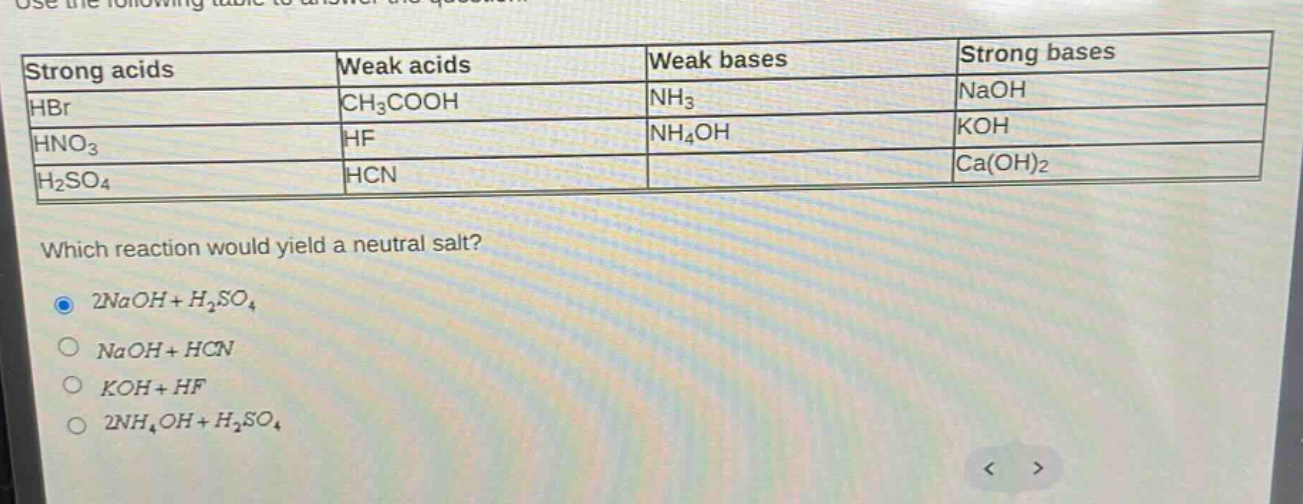
use the following table to answer the question.\n| strong acids | weak acids | weak bases | strong bases |\n| ---- | ---- | ---- | ---- |\n| hbr | ch₃cooh | nh₃ | naoh |\n| hno₃ | hf | nh₄oh | koh |\n| h₂so₄ | hcn | | ca(oh)₂ |\nwhich reaction would yield a neutral salt?\n2naoh + h₂so₄\nnaoh + hcn\nkoh + hf\n2nh₄oh + h₂so₄
Answer
Explanation:
Step1: Recall salt - formation rules
A neutral salt is formed when a strong acid reacts with a strong base.
Step2: Analyze each option
- For $2NaOH + H_2SO_4$: $NaOH$ is a strong base and $H_2SO_4$ is a strong acid. The reaction is $2NaOH + H_2SO_4=Na_2SO_4 + 2H_2O$, and $Na_2SO_4$ is a neutral salt.
- For $NaOH + HCN$: $NaOH$ is a strong base but $HCN$ is a weak acid. The salt formed will be basic.
- For $KOH + HF$: $KOH$ is a strong base but $HF$ is a weak acid. The salt formed will be basic.
- For $2NH_4OH + H_2SO_4$: $NH_4OH$ is a weak base and $H_2SO_4$ is a strong acid. The salt formed will be acidic.
Answer:
$2NaOH + H_2SO_4$