use the following table to answer the question.\n\n| strong acids | weak acids | weak bases | strong bases…
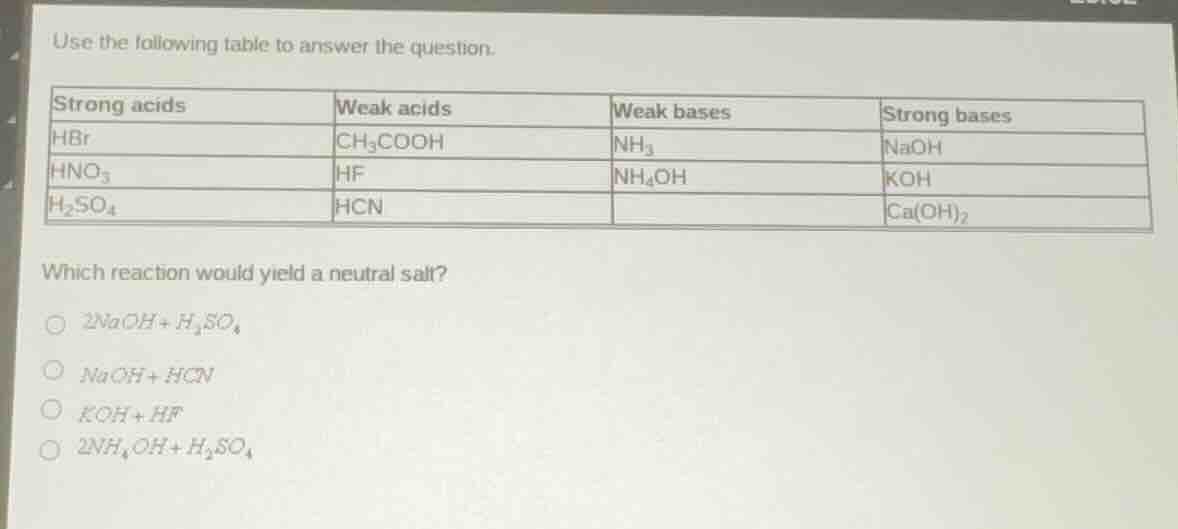
use the following table to answer the question.\n\n| strong acids | weak acids | weak bases | strong bases |\n| :--- | :--- | :--- | :--- |\n| $hbr$ | $ch_{3}cooh$ | $nh_{3}$ | $naoh$ |\n| $hno_{3}$ | $hf$ | $nh_{4}oh$ | $koh$ |\n| $h_{2}so_{4}$ | $hcn$ | | $ca(oh)_{2}$ |\n\nwhich reaction would yield a neutral salt?\n\n$2naoh + h_{2}so_{4}$\n$naoh + hcn$\n$koh + hf$\n$2nh_{4}oh + h_{2}so_{4}$
Answer
Explanation:
Step1: Identify neutral salt conditions
Neutral salts form from strong acids and strong bases.
Step2: Analyze first reaction components
$NaOH$ is a strong base; $H_{2}SO_{4}$ is a strong acid.
Step3: Analyze second reaction components
$NaOH$ is a strong base; $HCN$ is a weak acid.
Step4: Analyze third reaction components
$KOH$ is a strong base; $HF$ is a weak acid.
Step5: Analyze fourth reaction components
$NH_{4}OH$ is a weak base; $H_{2}SO_{4}$ is a strong acid.
Step6: Select the matching pair
Only $2NaOH + H_{2}SO_{4}$ involves both strong components.
Answer:
$2NaOH + H_{2}SO_{4}$