use the information to answer the following question. steel is one of the most common alloys of iron. due to…
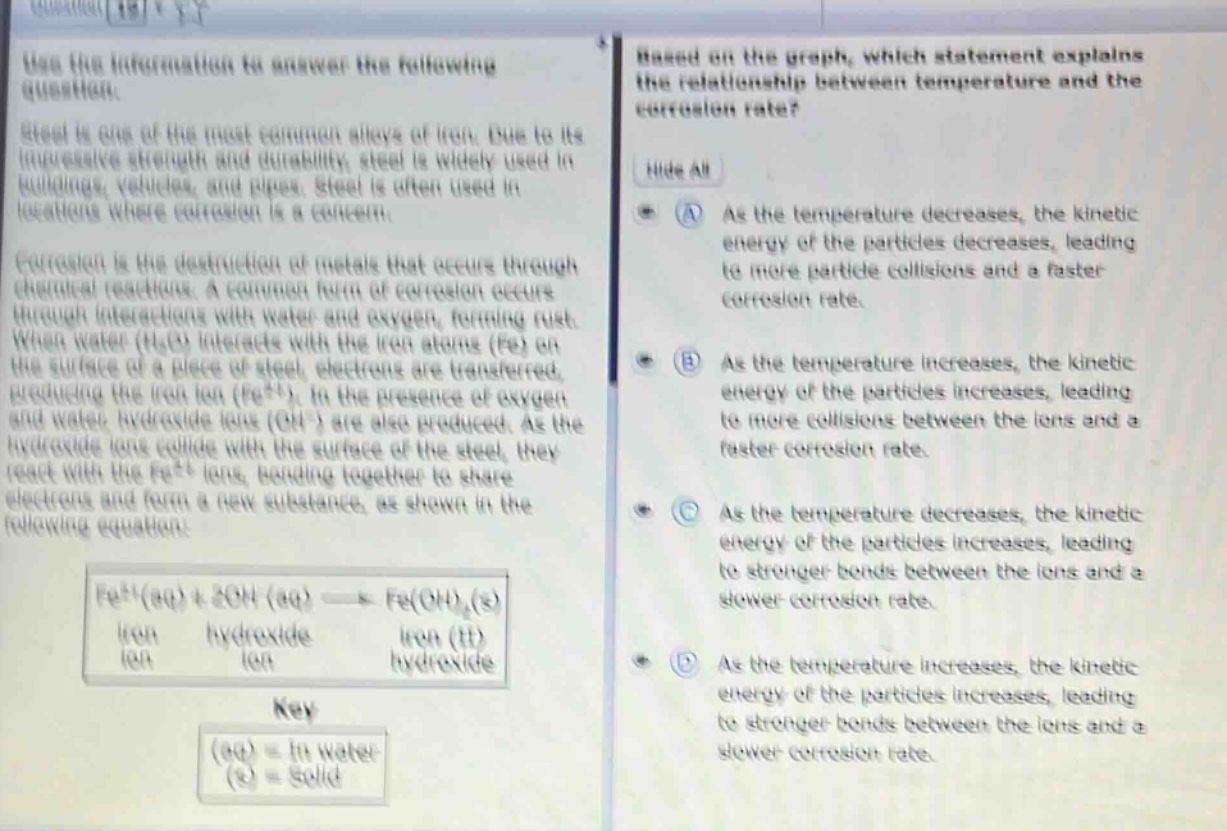
use the information to answer the following question. steel is one of the most common alloys of iron. due to its impressive strength and durability, steel is widely used in buildings, vehicles, and pipes. steel is often used in locations where corrosion is a concern. corrosion is the destruction of metals that occurs through chemical reactions. a common form of corrosion occurs through interactions with water and oxygen, forming rust. when water (h2o) interacts with the iron atoms (fe) on the surface of a piece of steel, electrons are transferred, producing the iron ion (fe2+). in the presence of oxygen and water, hydroxide ions (oh -) are also produced. as the hydroxide ions collide with the surface of the steel, they react with the fe2+ ions, bonding together to share electrons and form a new substance, as shown in the following equation: fe2+(aq) + 2oh-(aq) → fe(oh)2(s) iron ion hydroxide ion iron (ii) hydroxide key (aq) = in water (s) = solid based on the graph, which statement explains the relationship between temperature and the corrosion rate? hide all a as the temperature decreases, the kinetic energy of the particles decreases, leading to more particle collisions and a faster corrosion rate. b as the temperature increases, the kinetic energy of the particles increases, leading to more collisions between the ions and a faster corrosion rate. c as the temperature decreases, the kinetic energy of the particles increases, leading to stronger bonds between the ions and a slower corrosion rate. d as the temperature increases, the kinetic energy of the particles increases, leading to stronger bonds between the ions and a slower corrosion rate.
Answer
Brief Explanations:
La energía cinética de las partículas aumenta con la temperatura. En una reacción de corrosión, partículas con más energía cinética colliden más frecuentemente, lo que acelera la reacción. Por lo tanto, cuando la temperatura aumenta, la energía cinética de las partículas aumenta, lo que lleva a más colisiones entre los iones y una tasa de corrosión más rápida.
Answer:
B. As the temperature increases, the kinetic energy of the particles increases, leading to more collisions between the ions and a faster corrosion rate.