use lewis dot structures to show the covalent bonding in the following pairs of elements. then, draw the…
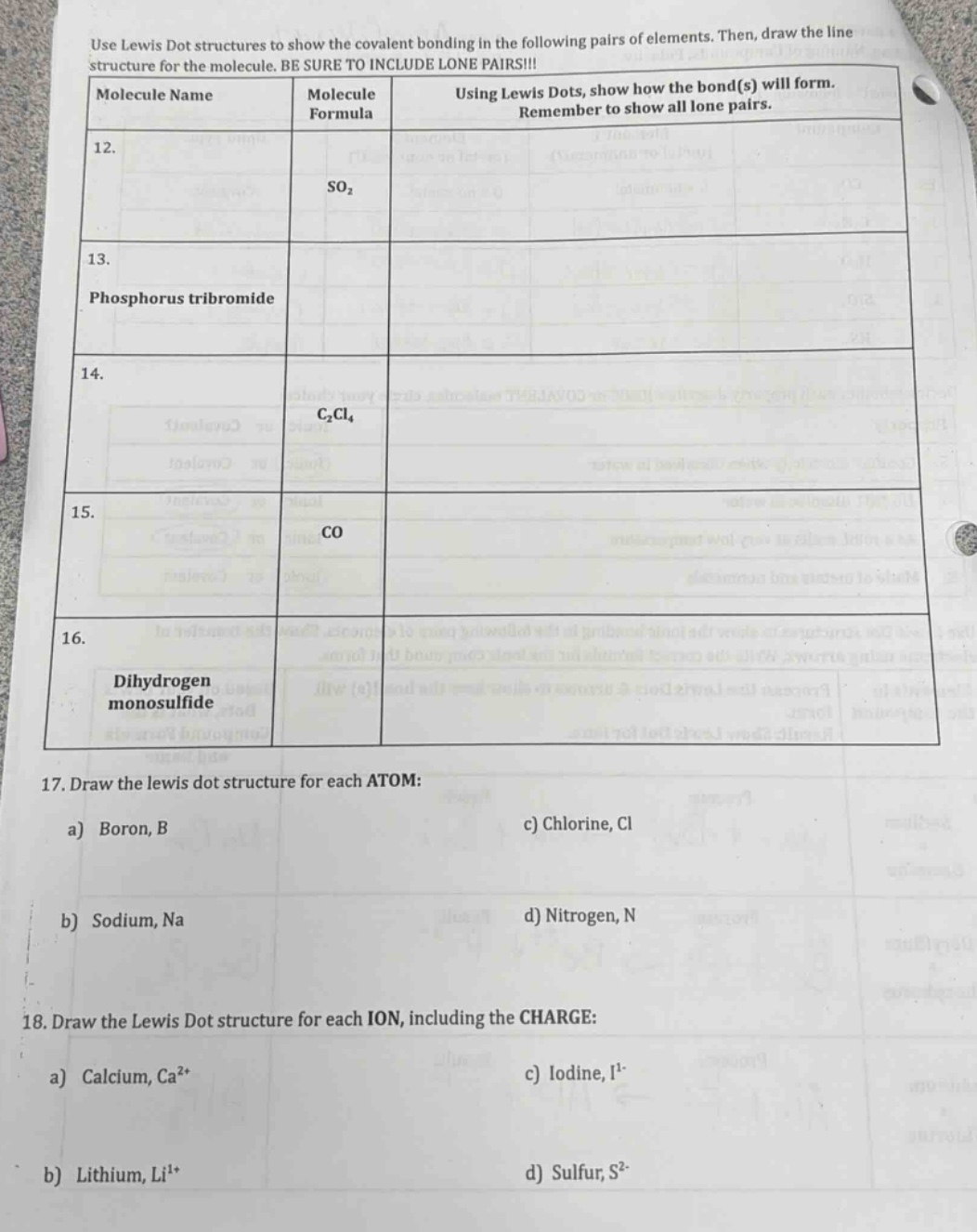
use lewis dot structures to show the covalent bonding in the following pairs of elements. then, draw the line structure for the molecule. be sure to include lone pairs!!!\n| molecule name | molecule formula | using lewis dots, show how the bond(s) will form. remember to show all lone pairs. |\n| ---- | ---- | ---- |\n| 12. | so₂ | |\n| 13. | phosphorus tribromide | |\n| 14. | c₂cl₄ | |\n| 15. | co | |\n| 16. | dihydrogen monosulfide | |\n17. draw the lewis dot structure for each atom:\na) boron, b c) chlorine, cl\nb) sodium, na d) nitrogen, n\n18. draw the lewis dot structure for each ion, including the charge:\na) calcium, ca²⁺ c) iodine, i⁻\nb) lithium, li⁺ d) sulfur, s²⁻
Answer
Explanation:
Step1: Determine valence electrons for $SO_2$
Sulfur (S) has 6 valence electrons and oxygen (O) has 6 valence electrons. For $SO_2$, total valence electrons = 6 + 2×6=18.
Step2: Draw Lewis - dot structure for $SO_2$
Place S in the center. Connect S to each O with a single - bond first, using 4 electrons. Then distribute the remaining 14 electrons as lone - pairs. One possible structure has a double - bond between S and one O, and a single - bond between S and the other O, with lone - pairs on all atoms to satisfy the octet rule.
Step3: Determine valence electrons for $PBr_3$
Phosphorus (P) has 5 valence electrons and bromine (Br) has 7 valence electrons. For $PBr_3$, total valence electrons = 5+3×7 = 26.
Step4: Draw Lewis - dot structure for $PBr_3$
Place P in the center. Connect P to each Br with a single - bond, using 6 electrons. Then distribute the remaining 20 electrons as lone - pairs, with 3 lone - pairs on each Br and 1 lone - pair on P.
Step5: Determine valence electrons for $C_2Cl_4$
Carbon (C) has 4 valence electrons and chlorine (Cl) has 7 valence electrons. For $C_2Cl_4$, total valence electrons = 2×4 + 4×7=36.
Step6: Draw Lewis - dot structure for $C_2Cl_4$
The two C atoms are double - bonded to each other. Each C is then bonded to 2 Cl atoms. Distribute the remaining electrons as lone - pairs on Cl atoms to satisfy the octet rule.
Step7: Determine valence electrons for $CO$
Carbon (C) has 4 valence electrons and oxygen (O) has 6 valence electrons. For $CO$, total valence electrons = 4 + 6=10.
Step8: Draw Lewis - dot structure for $CO$
Connect C and O with a triple - bond, using 6 electrons. Then distribute the remaining 4 electrons as 2 lone - pairs, one on C and one on O.
Step9: Determine valence electrons for $H_2S$
Hydrogen (H) has 1 valence electron and sulfur (S) has 6 valence electrons. For $H_2S$, total valence electrons = 2×1+6 = 8.
Step10: Draw Lewis - dot structure for $H_2S$
Place S in the center. Connect S to each H with a single - bond, using 4 electrons. Then distribute the remaining 4 electrons as 2 lone - pairs on S.
Step11: Draw Lewis - dot structure for B
Boron (B) has 3 valence electrons, so its Lewis - dot structure has 3 dots around the B atom.
Step12: Draw Lewis - dot structure for Na
Sodium (Na) has 1 valence electron, so its Lewis - dot structure has 1 dot around the Na atom.
Step13: Draw Lewis - dot structure for Cl
Chlorine (Cl) has 7 valence electrons, so its Lewis - dot structure has 7 dots around the Cl atom.
Step14: Draw Lewis - dot structure for N
Nitrogen (N) has 5 valence electrons, so its Lewis - dot structure has 5 dots around the N atom.
Step15: Draw Lewis - dot structure for $Ca^{2 + }$
Calcium (Ca) loses 2 electrons to form $Ca^{2+}$. Since it has lost its valence electrons, the Lewis - dot structure of $Ca^{2+}$ has no dots and is represented as $Ca^{2+}$.
Step16: Draw Lewis - dot structure for $Li^{+}$
Lithium (Li) loses 1 electron to form $Li^{+}$. Since it has lost its valence electron, the Lewis - dot structure of $Li^{+}$ has no dots and is represented as $Li^{+}$.
Step17: Draw Lewis - dot structure for $I^{-}$
Iodine (I) has 7 valence electrons and gains 1 electron to form $I^{-}$. So it has 8 valence electrons. Its Lewis - dot structure has 8 dots around the I atom with a negative charge outside the brackets: $[:\ddot{I}:]^{-}$.
Step18: Draw Lewis - dot structure for $S^{2 - }$
Sulfur (S) has 6 valence electrons and gains 2 electrons to form $S^{2-}$. So it has 8 valence electrons. Its Lewis - dot structure has 8 dots around the S atom with a negative charge outside the brackets: $[:\ddot{S}:]^{2 - }$.
Answer:
The Lewis - dot structures and line structures for the given molecules and atoms/ions are as described above. For molecules, the line structures can be derived from the Lewis - dot structures by representing bonds as lines and lone - pairs can be optionally shown depending on the context. For atoms and ions, the Lewis - dot structures are the final answer as required.