use the references to access important values if needed for this question.\na 33.4 ml sample of a 0.518 m…
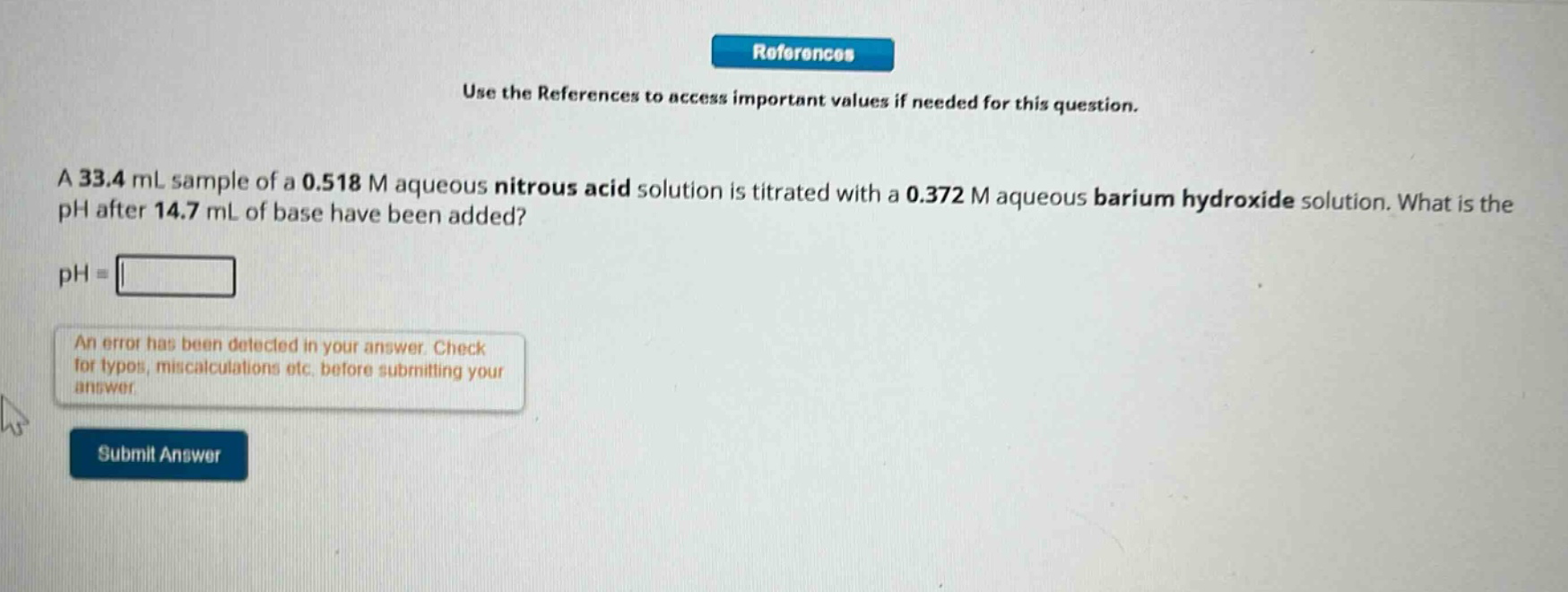
use the references to access important values if needed for this question.\na 33.4 ml sample of a 0.518 m aqueous nitrous acid solution is titrated with a 0.372 m aqueous barium hydroxide solution. what is the ph after 14.7 ml of base have been added?\nph=\nan error has been detected in your answer. check for typos, miscalculations etc. before submitting your answer.\nsubmit answer
Answer
Explanation:
Step1: Calculate the moles of nitrous acid ($\ce{HNO2}$)
Use the formula $n = C\times V$ (where $n$ is moles, $C$ is concentration, $V$ is volume in liters). For $\ce{HNO2}$: $C = 0.518\ M$, $V=33.4\ mL=0.0334\ L$ $n_{\ce{HNO2}}=0.518\times0.0334 = 0.0173\ mol$
Step2: Calculate the moles of $\ce{Ba(OH)2}$
For $\ce{Ba(OH)2}$: $C = 0.372\ M$, $V = 14.7\ mL=0.0147\ L$ $n_{\ce{Ba(OH)2}}=0.372\times0.0147=0.00547\ mol$
Step3: Determine the moles of $\ce{OH-}$ from $\ce{Ba(OH)2}$
Since $1\ mol\ \ce{Ba(OH)2}$ gives $2\ mol\ \ce{OH-}$, $n_{\ce{OH-}}=2\times0.00547 = 0.0109\ mol$
Step4: Calculate the moles of $\ce{HNO2}$ remaining after reaction
The reaction is $\ce{HNO2 + OH- -> NO2- + H2O}$ Moles of $\ce{HNO2}$ remaining: $n_{\ce{HNO2 (remaining)}}=0.0173 - 0.0109=0.0064\ mol$
Step5: Calculate the total volume of the solution
$V_{total}=33.4 + 14.7=48.1\ mL = 0.0481\ L$
Step6: Calculate the concentration of $\ce{HNO2}$ remaining
$C_{\ce{HNO2}}=\frac{0.0064}{0.0481}\approx0.133\ M$
Step7: Use the Ka of $\ce{HNO2}$ ($Ka = 4.5\times 10^{-4}$) to find $[H+]$
For $\ce{HNO2 <=> H+ + NO2-}$, $Ka=\frac{[H+][NO2-]}{[HNO2]}$ Assume $[H+]=x$, then $[NO2-]=x$ and $[HNO2]=0.133 - x\approx0.133$ (since $x$ is small) $4.5\times 10^{-4}=\frac{x\times x}{0.133}$ $x^{2}=4.5\times 10^{-4}\times0.133$ $x^{2}=5.985\times 10^{-5}$ $x=\sqrt{5.985\times 10^{-5}}\approx7.74\times 10^{-3}\ M$
Step8: Calculate pH
$pH=-\log[H+]=-\log(7.74\times 10^{-3})\approx2.11$
Answer:
$2.11$