use the solubility generalizations on the information page to predict if one or more precipitates will form…
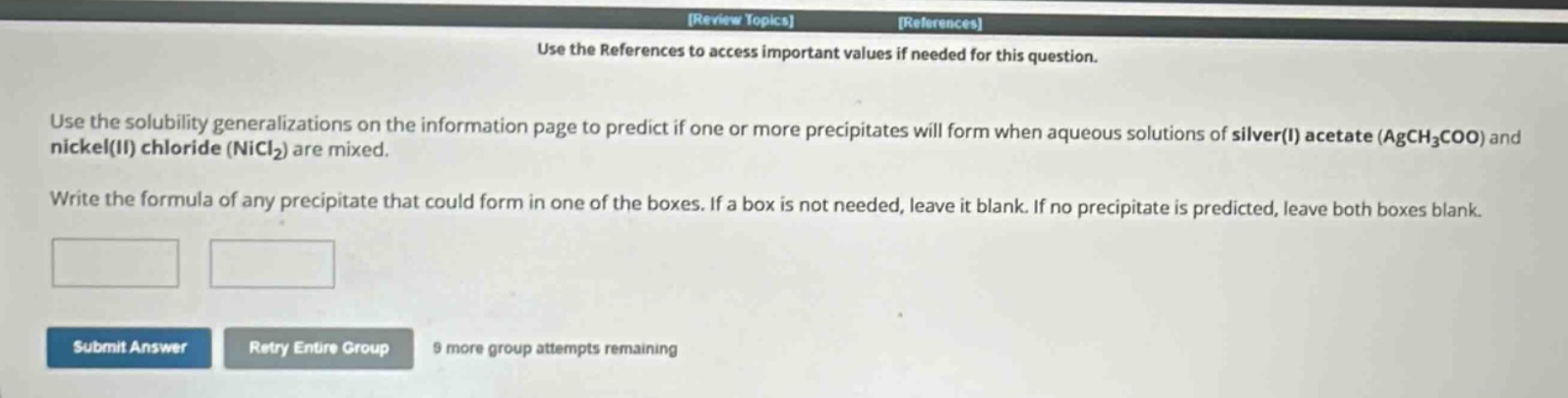
use the solubility generalizations on the information page to predict if one or more precipitates will form when aqueous solutions of silver(i) acetate (agch₃coo) and nickel(ii) chloride (nicl₂) are mixed. write the formula of any precipitate that could form in one of the boxes. if a box is not needed, leave it blank. if no precipitate is predicted, leave both boxes blank.
Answer
Explanation:
Step1: Write the chemical reaction equation
When aqueous solutions of silver(I) acetate ($\ce{AgCH3COO}$) and nickel(II) chloride ($\ce{NiCl2}$) are mixed, a double - displacement reaction occurs. The general form of a double - displacement reaction is $\ce{AB + CD\rightarrow AD+CB}$. So, $\ce{2AgCH3COO(aq)+NiCl2(aq)\rightarrow 2AgCl(s)+Ni(CH3COO)2(aq)}$
Step2: Use solubility rules
- Solubility rules: Most chloride salts are soluble. However, $\ce{AgCl}$ is insoluble.
- For acetate salts: Most acetate salts ($\ce{CH3COO^{-}}$ salts) are soluble. $\ce{Ni(CH3COO)2}$ is soluble in water.
Answer:
$\ce{AgCl}$