use the table to compare the solubilities of substances. check all of the boxes that apply. aspirin is less…
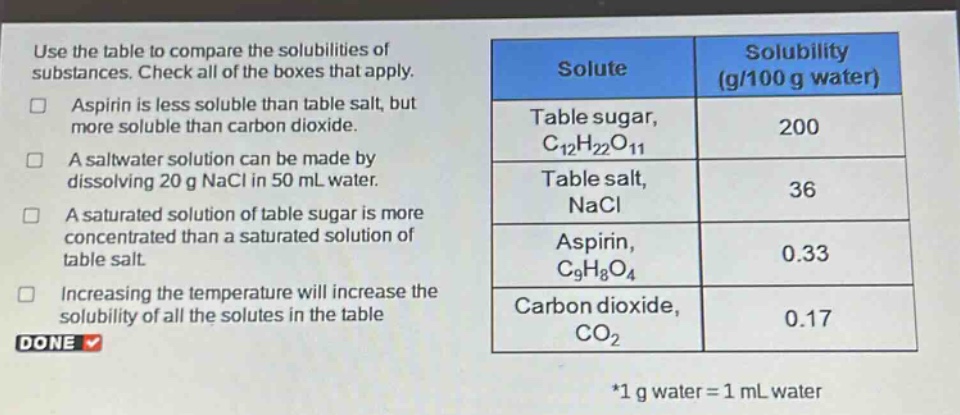
use the table to compare the solubilities of substances. check all of the boxes that apply. aspirin is less soluble than table salt, but more soluble than carbon dioxide. a saltwater solution can be made by dissolving 20 g nacl in 50 ml water. a saturated solution of table sugar is more concentrated than a saturated solution of table salt. increasing the temperature will increase the solubility of all the solutes in the table. *1 g water = 1 ml water
Answer
Explanation:
Step1: Analyze solubility comparison
Aspirin solubility is 0.33 g/100 g water, table - salt is 36 g/100 g water and carbon - dioxide is 0.17 g/100 g water. So, 0.17<0.33<36, and the statement "Aspirin is less soluble than table salt, but more soluble than carbon dioxide" is correct.
Step2: Check salt - water solution formation
The solubility of table salt is 36 g/100 g water. In 50 mL (50 g) water, the maximum amount of NaCl that can dissolve is $\frac{36}{100}\times50 = 18$ g. Dissolving 20 g NaCl in 50 mL water is not possible as it exceeds the solubility limit, so this statement is incorrect.
Step3: Compare solution concentrations
The solubility of table sugar is 200 g/100 g water and of table salt is 36 g/100 g water. A saturated solution of table sugar has a higher solute - to - solvent ratio, so it is more concentrated. This statement is correct.
Step4: Consider temperature effect
In general, the solubility of gases (like carbon dioxide) decreases with increasing temperature, so the statement "Increasing the temperature will increase the solubility of all the solutes in the table" is incorrect.
Answer:
Aspirin is less soluble than table salt, but more soluble than carbon dioxide. A saturated solution of table sugar is more concentrated than a saturated solution of table salt.