which are valid compounds? select all that apply.
which are valid compounds? select all that apply.
Answer
Explanation:
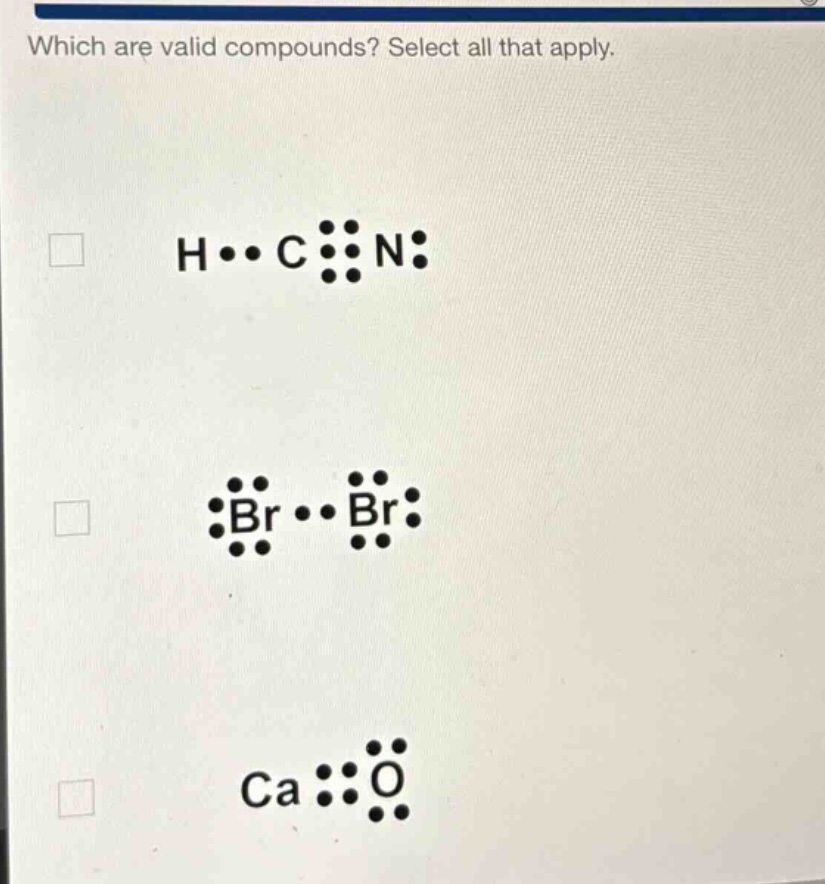
Step1: Analyze H - C≡N
Hydrogen (H) has 1 valence electron and forms 1 bond, carbon (C) has 4 valence electrons and can form 4 bonds, nitrogen (N) has 5 valence electrons and can form 3 bonds. In H - C≡N, the bonding satisfies the octet rule for C and N and the duet rule for H.
Step2: Analyze Br - Br
Bromine (Br) is a halogen with 7 valence electrons. In Br - Br, each Br atom shares one pair of electrons to achieve an octet of electrons.
Step3: Analyze Ca - O
Calcium (Ca) is a metal and oxygen (O) is a non - metal. Calcium loses 2 electrons to form a Ca²⁺ ion and oxygen gains 2 electrons to form an O²⁻ ion. The correct way to represent the ionic compound is Ca²⁺O²⁻ and not a simple Lewis - dot structure as shown (the Lewis - dot structure shown implies a covalent bond which is incorrect for CaO).
Answer:
H• •C:::N:, Br• •Br: