water is called the \universal solvent.\ which statement best explains this description with respect to…
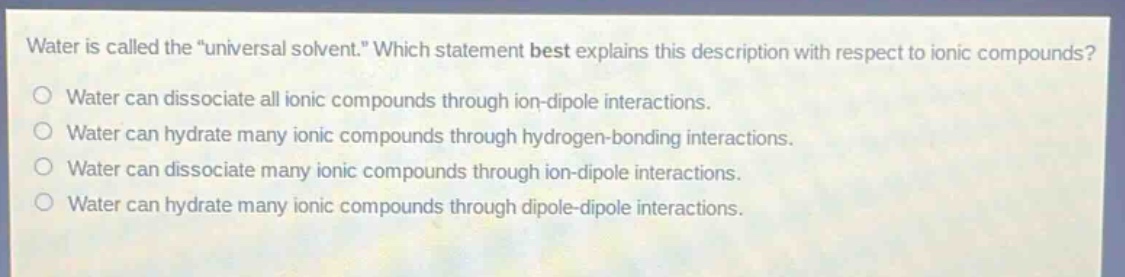
water is called the \universal solvent.\ which statement best explains this description with respect to ionic compounds?\no water can dissociate all ionic compounds through ion - dipole interactions.\no water can hydrate many ionic compounds through hydrogen - bonding interactions.\no water can dissociate many ionic compounds through ion - dipole interactions.\no water can hydrate many ionic compounds through dipole - dipole interactions.
Answer
Brief Explanations:
Water is a polar molecule with a partial - positive and partial - negative end. Ionic compounds are made of ions. Ion - dipole interactions occur between ions and polar molecules. Water can dissociate many ionic compounds by surrounding the ions with its polar ends through ion - dipole interactions, which is why it is called the "universal solvent". Hydrogen - bonding is between molecules with O - H, N - H or F - H bonds and is not the main interaction for dissociating ionic compounds. Dipole - dipole interactions are between polar molecules and not relevant here for ionic compound dissociation.
Answer:
Water can dissociate many ionic compounds through ion - dipole interactions.