when water freezes to form ice, energy is...\na absorbed\nb created\nc released\nd destroyed\n12. the dew…
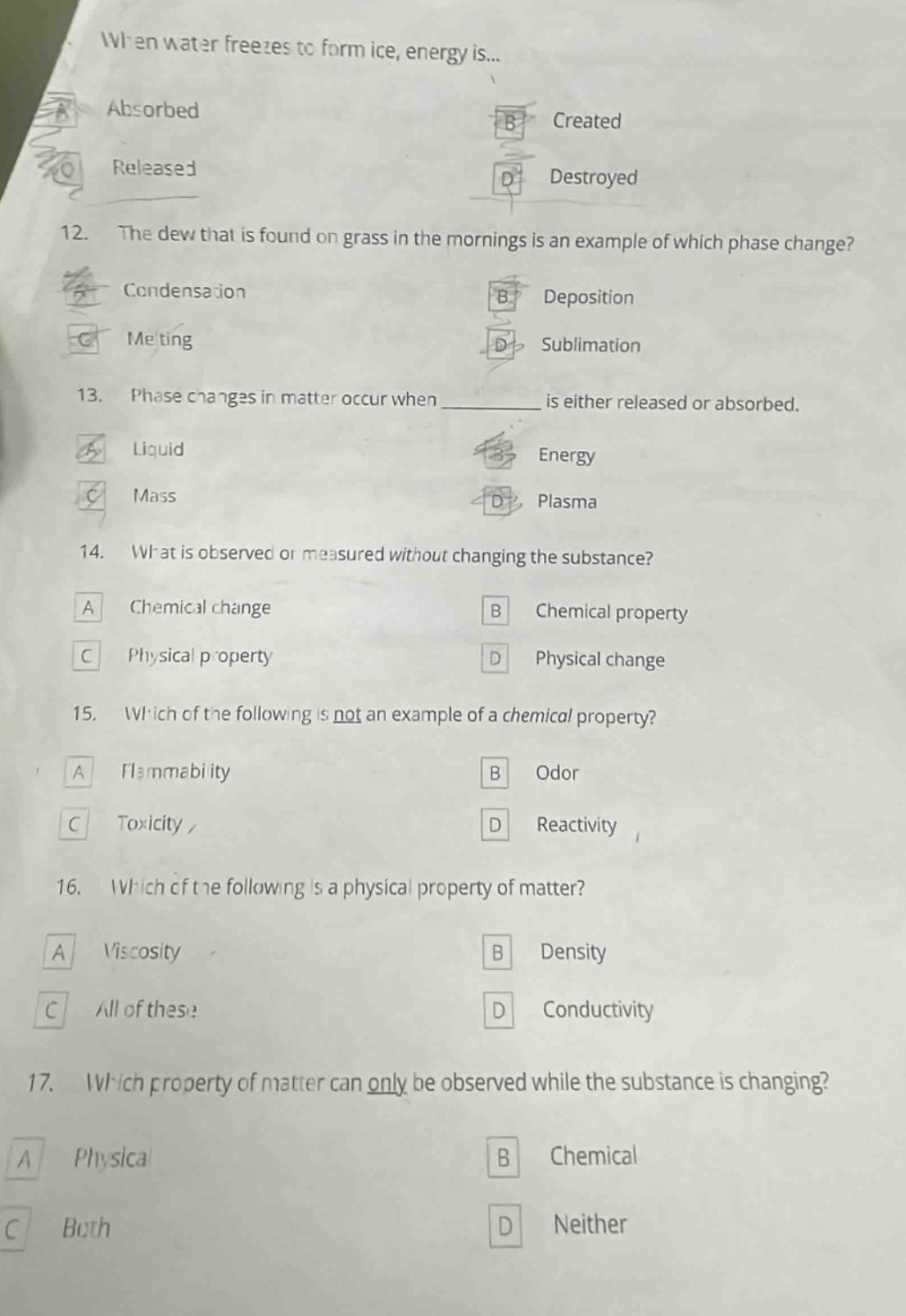
when water freezes to form ice, energy is...\na absorbed\nb created\nc released\nd destroyed\n12. the dew that is found on grass in the mornings is an example of which phase change?\na condensation\nb deposition\nc melting\nd sublimation\n13. phase changes in matter occur when ______ is either released or absorbed.\na liquid\nb energy\nc mass\nd plasma\n14. what is observed or measured without changing the substance?\na chemical change\nb chemical property\nc physical property\nd physical change\n15. which of the following is not an example of a chemical property?\na flammability\nb odor\nc toxicity\nd reactivity\n16. which of the following is a physical property of matter?\na viscosity\nb density\nc all of these\nd conductivity\n17. which property of matter can only be observed while the substance is changing?\na physical\nb chemical\nc both\nd neither
Answer
Brief Explanations:
- When water freezes to ice, it is an exothermic process, so energy is released.
- Dew on grass is formed when water - vapor in the air changes to liquid water, which is condensation.
- Phase changes in matter occur due to the release or absorption of energy.
- Physical properties are observed or measured without changing the substance.
- Odor is a physical property, while flammability, toxicity, and reactivity are chemical properties.
- Viscosity, density, and conductivity are all physical properties of matter.
- Chemical properties can only be observed when the substance is changing.
Answer:
- C. Released
- A. Condensation
- B. Energy
- C. Physical property
- B. Odor
- C. All of these
- B. Chemical