a water sample shows 0.029 grams of some trace element for every cubic centimeter of water. parker uses a…
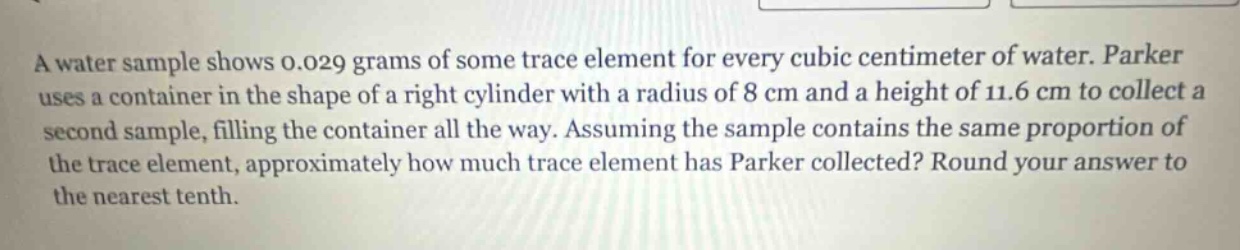
a water sample shows 0.029 grams of some trace element for every cubic centimeter of water. parker uses a container in the shape of a right cylinder with a radius of 8 cm and a height of 11.6 cm to collect a second sample, filling the container all the way. assuming the sample contains the same proportion of the trace element, approximately how much trace element has parker collected? round your answer to the nearest tenth.
Answer
Explanation:
Step1: Calculate volume of cylinder
The volume formula for a cylinder is $V=\pi r^{2}h$. Given $r = 8$ cm and $h=11.6$ cm. So $V=\pi\times8^{2}\times11.6=\pi\times64\times11.6 = 742.4\pi$ $cm^{3}$.
Step2: Calculate amount of trace - element
The proportion of trace - element is 0.029 grams per $cm^{3}$. So the amount of trace - element $m = 0.029\times V$. Substitute $V = 742.4\pi$ into the formula: $m=0.029\times742.4\pi$. $m=0.029\times742.4\times3.14$. $m = 0.029\times2331.136$. $m\approx67.6$ grams.
Answer:
67.6 grams