we use electronegativity values when we discuss bond polarity. if two atoms sharing a pair of electrons have…
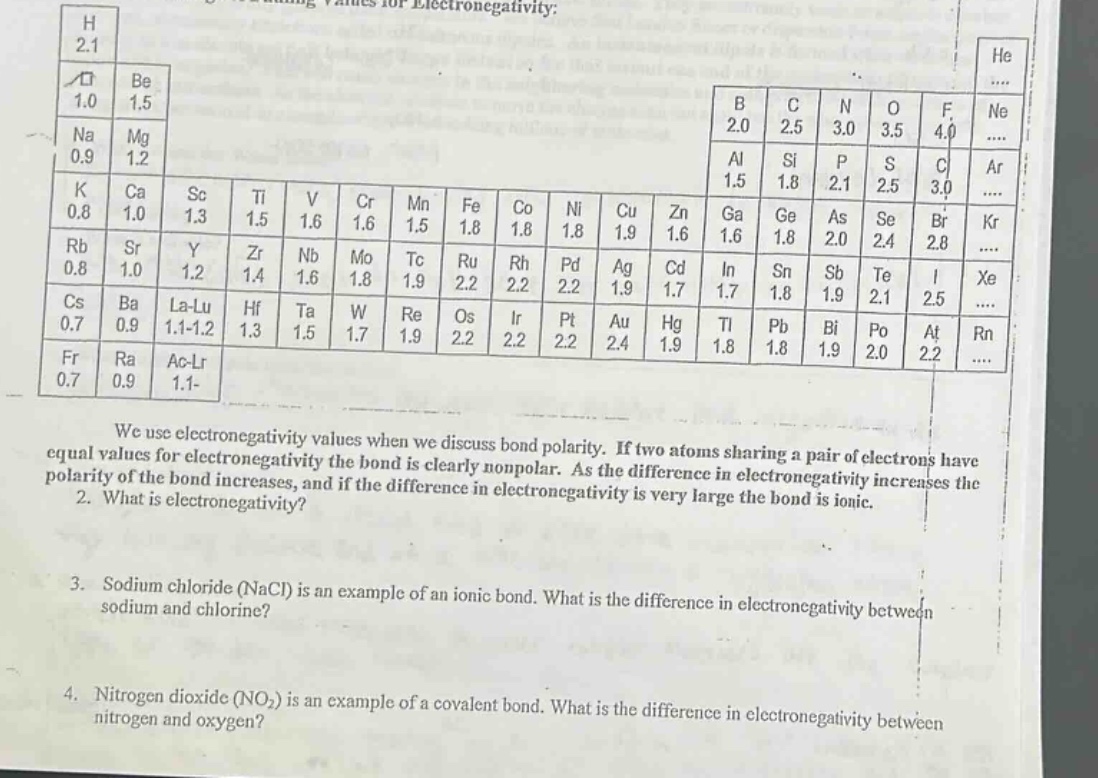
we use electronegativity values when we discuss bond polarity. if two atoms sharing a pair of electrons have equal values for electronegativity the bond is clearly nonpolar. as the difference in electronegativity increases the polarity of the bond increases, and if the difference in electronegativity is very large the bond is ionic.\n2. what is electronegativity?\n3. sodium chloride (nacl) is an example of an ionic bond. what is the difference in electronegativity between sodium and chlorine?\n4. nitrogen dioxide (no₂) is an example of a covalent bond. what is the difference in electronegativity between nitrogen and oxygen?
Answer
Explanation:
Step1: Define electronegativity
Electronegativity is the ability of an atom in a chemical bond to attract electrons to itself.
Step2: Find electronegativity of Na and Cl for NaCl
From the table, electronegativity of Na = 0.9, electronegativity of Cl = 3.0. Difference = 3.0 - 0.9 = 2.1
Step3: Find electronegativity of N and O for NO₂
From the table, electronegativity of N = 3.0, electronegativity of O = 3.5. Difference = 3.5 - 3.0 = 0.5
Answer:
- Electronegativity is the ability of an atom in a chemical bond to attract electrons to itself.
- 2.1
- 0.5