worksheet #5: double - replacement reactions\nin these reactions, all you do is look at the names of the…
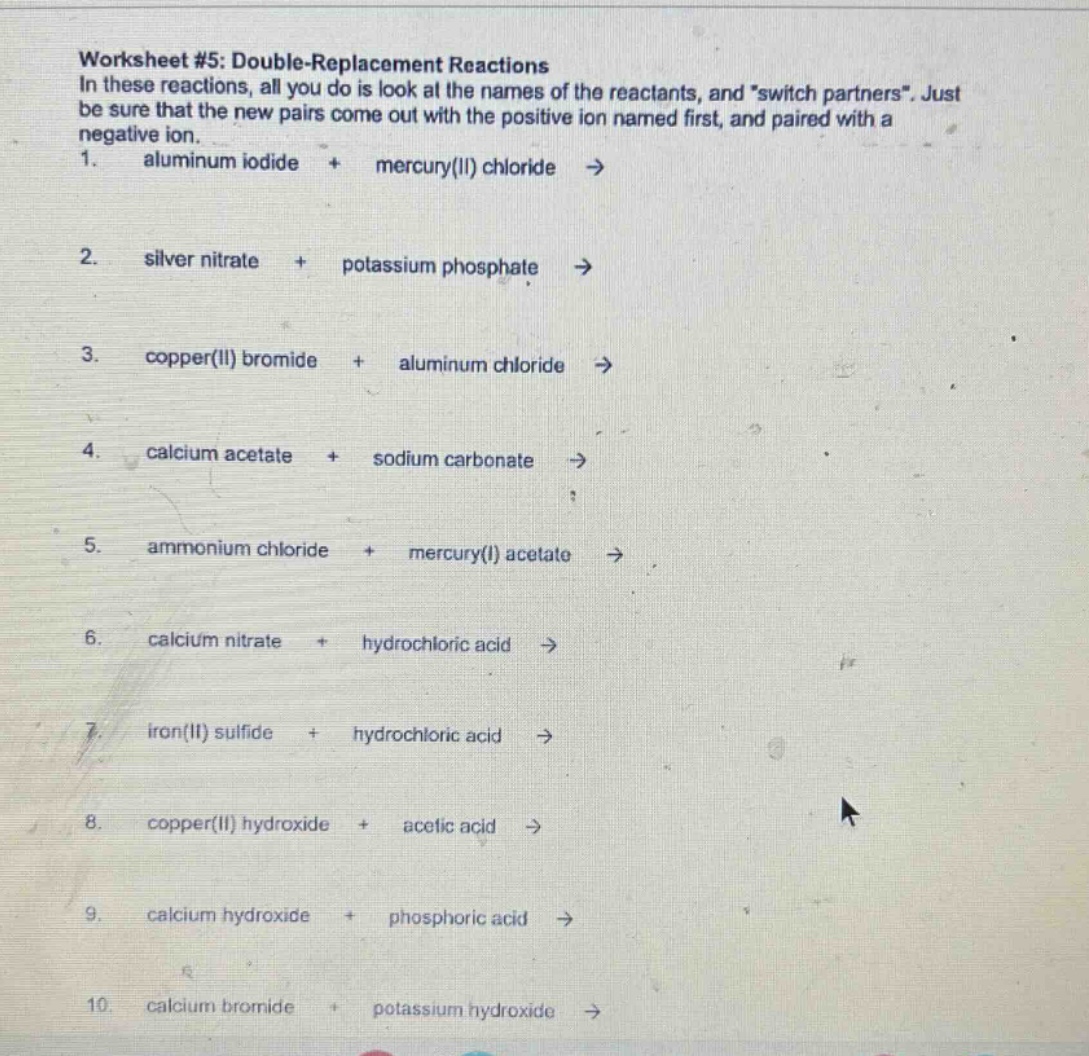
worksheet #5: double - replacement reactions\nin these reactions, all you do is look at the names of the reactants, and \switch partners\. just be sure that the new pairs come out with the positive ion named first, and paired with a negative ion.\n1. aluminum iodide + mercury(ii) chloride ->\n2. silver nitrate + potassium phosphate ->\n3. copper(ii) bromide + aluminum chloride ->\n4. calcium acetate + sodium carbonate ->\n5. ammonium chloride + mercury(i) acetate ->\n6. calcium nitrate + hydrochloric acid ->\n7. iron(ii) sulfide + hydrochloric acid ->\n8. copper(ii) hydroxide + acetic acid ->\n9. calcium hydroxide + phosphoric acid ->\n10. calcium bromide + potassium hydroxide ->
Answer
Explanation:
Step1: Write chemical formulas
Aluminum iodide is $AlI_3$, mercury(II) chloride is $HgCl_2$. In double - replacement reaction, the products are aluminum chloride $AlCl_3$ and mercury(II) iodide $HgI_2$. The balanced chemical equation is $2AlI_3 + 3HgCl_2=2AlCl_3 + 3HgI_2$.
Step2: For silver nitrate ($AgNO_3$) and potassium phosphate ($K_3PO_4$)
The products are silver phosphate ($Ag_3PO_4$) and potassium nitrate ($KNO_3$). The balanced equation is $3AgNO_3+K_3PO_4 = Ag_3PO_4\downarrow+3KNO_3$.
Step3: For copper(II) bromide ($CuBr_2$) and aluminum chloride ($AlCl_3$)
The products are copper(II) chloride ($CuCl_2$) and aluminum bromide ($AlBr_3$). The balanced equation is $3CuBr_2 + 2AlCl_3=3CuCl_2 + 2AlBr_3$.
Step4: For calcium acetate ($Ca(CH_3COO)_2$) and sodium carbonate ($Na_2CO_3$)
The products are calcium carbonate ($CaCO_3$) and sodium acetate ($NaCH_3COO$). The balanced equation is $Ca(CH_3COO)_2+Na_2CO_3 = CaCO_3\downarrow + 2NaCH_3COO$.
Step5: For ammonium chloride ($NH_4Cl$) and mercury(I) acetate ($Hg_2(CH_3COO)_2$)
The products are ammonium acetate ($NH_4CH_3COO$) and mercury(I) chloride ($Hg_2Cl_2$). The balanced equation is $2NH_4Cl+Hg_2(CH_3COO)_2 = 2NH_4CH_3COO+Hg_2Cl_2\downarrow$.
Step6: For calcium nitrate ($Ca(NO_3)_2$) and hydrochloric acid ($HCl$)
The products are calcium chloride ($CaCl_2$) and nitric acid ($HNO_3$). The balanced equation is $Ca(NO_3)_2 + 2HCl=CaCl_2+2HNO_3$.
Step7: For iron(II) sulfide ($FeS$) and hydrochloric acid ($HCl$)
The products are iron(II) chloride ($FeCl_2$) and hydrogen sulfide ($H_2S$). The balanced equation is $FeS + 2HCl=FeCl_2+H_2S\uparrow$.
Step8: For copper(II) hydroxide ($Cu(OH)_2$) and acetic acid ($CH_3COOH$)
The products are copper(II) acetate ($Cu(CH_3COO)_2$) and water ($H_2O$). The balanced equation is $Cu(OH)_2 + 2CH_3COOH=Cu(CH_3COO)_2+2H_2O$.
Step9: For calcium hydroxide ($Ca(OH)_2$) and phosphoric acid ($H_3PO_4$)
The products are calcium phosphate ($Ca_3(PO_4)_2$) and water ($H_2O$). The balanced equation is $3Ca(OH)_2+2H_3PO_4 = Ca_3(PO_4)_2\downarrow+6H_2O$.
Step10: For calcium bromide ($CaBr_2$) and potassium hydroxide ($KOH$)
The products are calcium hydroxide ($Ca(OH)_2$) and potassium bromide ($KBr$). Since calcium hydroxide is slightly soluble, if the concentrations are high enough, a precipitate may form. The balanced equation is $CaBr_2 + 2KOH=Ca(OH)_2\downarrow+2KBr$.
Answer:
- $2AlI_3 + 3HgCl_2=2AlCl_3 + 3HgI_2$
- $3AgNO_3+K_3PO_4 = Ag_3PO_4\downarrow+3KNO_3$
- $3CuBr_2 + 2AlCl_3=3CuCl_2 + 2AlBr_3$
- $Ca(CH_3COO)_2+Na_2CO_3 = CaCO_3\downarrow + 2NaCH_3COO$
- $2NH_4Cl+Hg_2(CH_3COO)_2 = 2NH_4CH_3COO+Hg_2Cl_2\downarrow$
- $Ca(NO_3)_2 + 2HCl=CaCl_2+2HNO_3$
- $FeS + 2HCl=FeCl_2+H_2S\uparrow$
- $Cu(OH)_2 + 2CH_3COOH=Cu(CH_3COO)_2+2H_2O$
- $3Ca(OH)_2+2H_3PO_4 = Ca_3(PO_4)_2\downarrow+6H_2O$
- $CaBr_2 + 2KOH=Ca(OH)_2\downarrow+2KBr$