5. write the balanced redox reaction for the decomposition of hydrogen peroxide (h₂o₂) into water and oxygen…
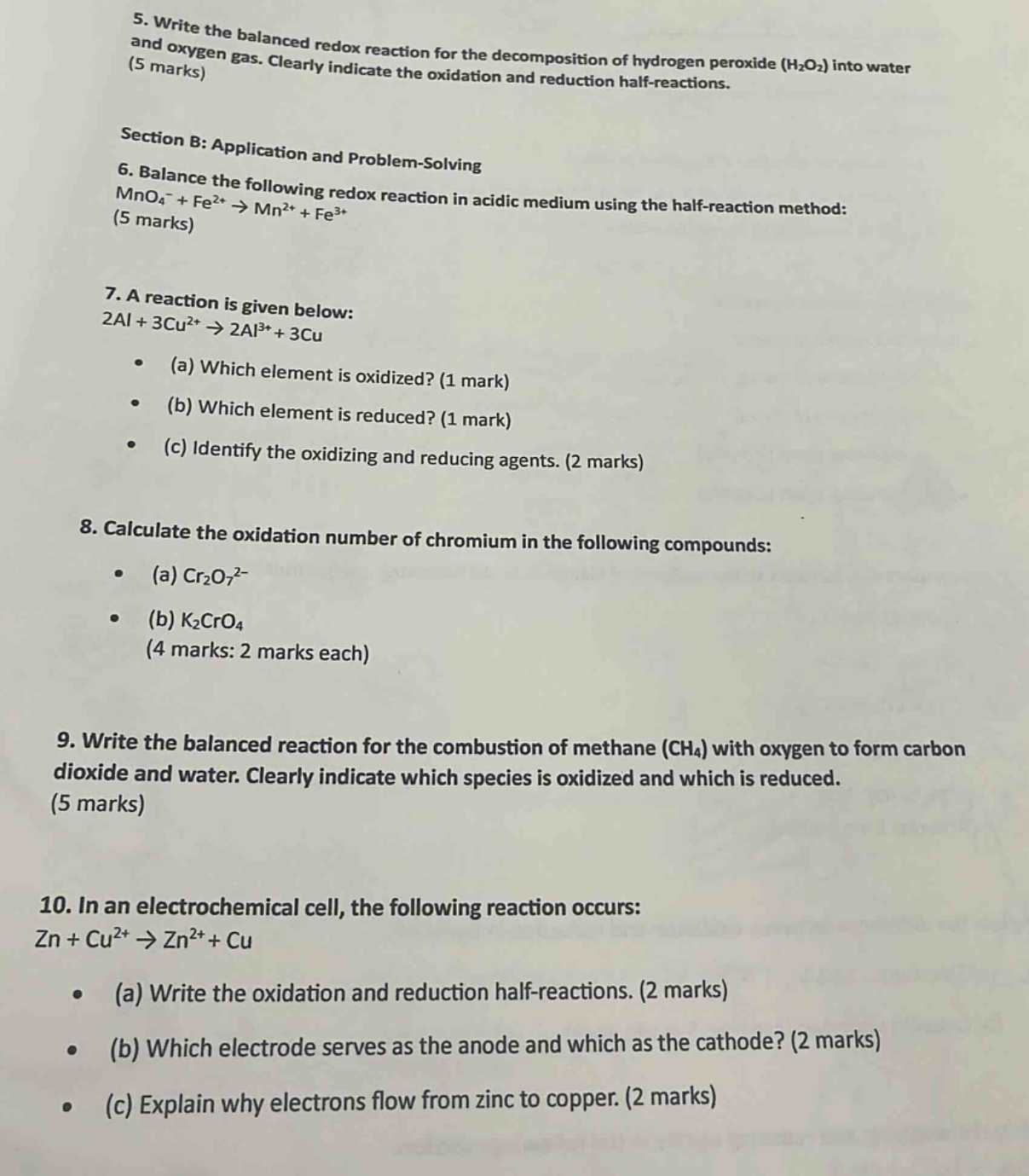
5. write the balanced redox reaction for the decomposition of hydrogen peroxide (h₂o₂) into water and oxygen gas. clearly indicate the oxidation and reduction half - reactions. (5 marks)\nsection b: application and problem - solving\n6. balance the following redox reaction in acidic medium using the half - reaction method: mno₄⁻+fe²⁺→mn²⁺+fe³⁺ (5 marks)\n7. a reaction is given below: 2al + 3cu²⁺→2al³⁺+3cu\n(a) which element is oxidized? (1 mark)\n(b) which element is reduced? (1 mark)\n(c) identify the oxidizing and reducing agents. (2 marks)\n8. calculate the oxidation number of chromium in the following compounds:\n(a) cr₂o₇²⁻\n(b) k₂cro₄ (4 marks: 2 marks each)\n9. write the balanced reaction for the combustion of methane (ch₄) with oxygen to form carbon dioxide and water. clearly indicate which species is oxidized and which is reduced. (5 marks)\n10. in an electrochemical cell, the following reaction occurs: zn + cu²⁺→zn²⁺+cu\n(a) write the oxidation and reduction half - reactions. (2 marks)\n(b) which electrode serves as the anode and which as the cathode? (2 marks)\n(c) explain why electrons flow from zinc to copper. (2 marks)
Answer
5.
Explanation:
Step1: Write un - balanced reaction
$H_2O_2\rightarrow H_2O + O_2$
Step2: Oxidation half - reaction
The oxygen in $H_2O_2$ has an oxidation state of - 1. In $O_2$, it has an oxidation state of 0. $2H_2O_2\rightarrow 2H_2O+O_2 + 2e^-$ (oxidation, oxygen is oxidized)
Step3: Reduction half - reaction
The oxygen in $H_2O_2$ is also reduced. $2H_2O_2 + 2e^-\rightarrow 2H_2O$ (reduction)
Step4: Combine half - reactions
The overall balanced redox reaction is $2H_2O_2\rightarrow 2H_2O + O_2$
6.
Explanation:
Step1: Write half - reactions
Oxidation: $Fe^{2 + }\rightarrow Fe^{3+}+e^-$ Reduction: $MnO_4^-\rightarrow Mn^{2+}$
Step2: Balance oxygen in reduction half - reaction
$MnO_4^-\rightarrow Mn^{2+}+4H_2O$
Step3: Balance hydrogen in reduction half - reaction (acidic medium)
$MnO_4^- + 8H^+\rightarrow Mn^{2+}+4H_2O$
Step4: Balance electrons in reduction half - reaction
$MnO_4^- + 8H^++5e^-\rightarrow Mn^{2+}+4H_2O$
Step5: Multiply oxidation half - reaction to balance electrons
$5Fe^{2 + }\rightarrow 5Fe^{3+}+5e^-$
Step6: Combine half - reactions
$MnO_4^- + 5Fe^{2+}+8H^+\rightarrow Mn^{2+}+5Fe^{3+}+4H_2O$
7.
(a)
Explanation:
Aluminum goes from an oxidation state of 0 to + 3. So, Al is oxidized.
Answer:
Al
(b)
Explanation:
Copper goes from an oxidation state of + 2 to 0. So, Cu is reduced.
Answer:
Cu
(c)
Explanation:
The substance that is oxidized is the reducing agent (Al), and the substance that is reduced is the oxidizing agent ($Cu^{2+}$).
Answer:
Oxidizing agent: $Cu^{2+}$, Reducing agent: Al
8.
(a)
Explanation:
Let the oxidation number of Cr be $x$. In $Cr_2O_7^{2 - }$, oxygen has an oxidation number of - 2. $2x+7\times(- 2)=-2$ $2x - 14=-2$ $2x=12$ $x = + 6$
Answer:
+6
(b)
Explanation:
Let the oxidation number of Cr be $x$. In $K_2CrO_4$, potassium has an oxidation number of + 1 and oxygen has an oxidation number of - 2. $2\times(+1)+x + 4\times(-2)=0$ $2+x - 8=0$ $x=+6$
Answer:
+6
9.
Explanation:
Step1: Write un - balanced reaction
$CH_4+O_2\rightarrow CO_2+H_2O$
Step2: Balance the reaction
$CH_4 + 2O_2\rightarrow CO_2+2H_2O$ Carbon in $CH_4$ has an oxidation state of - 4 and in $CO_2$ it is + 4, so carbon is oxidized. Oxygen in $O_2$ has an oxidation state of 0 and in $CO_2$ and $H_2O$ it is - 2, so oxygen is reduced.
Answer:
$CH_4 + 2O_2\rightarrow CO_2+2H_2O$, Oxidized: C in $CH_4$, Reduced: O in $O_2$
10.
(a)
Explanation:
Oxidation: $Zn\rightarrow Zn^{2+}+2e^-$ Reduction: $Cu^{2+}+2e^-\rightarrow Cu$
Answer:
Oxidation: $Zn\rightarrow Zn^{2+}+2e^-$, Reduction: $Cu^{2+}+2e^-\rightarrow Cu$
(b)
Explanation:
In an electrochemical cell, the oxidation occurs at the anode and reduction at the cathode. Since Zn is oxidized, Zn is the anode and since $Cu^{2+}$ is reduced, Cu is the cathode.
Answer:
Anode: Zn, Cathode: Cu
(c)
Explanation:
Zinc has a lower reduction potential than copper. Zinc is more likely to lose electrons (oxidize) and these electrons flow through the external circuit to the copper electrode where $Cu^{2+}$ ions gain the electrons (reduce).
Answer:
Zinc has a lower reduction potential and is more easily oxidized, so electrons flow from Zn to Cu.