2. write the names for the following compounds.\n(a) li₂o ____________ (k) pbs ____________\n(b) alcl₃…
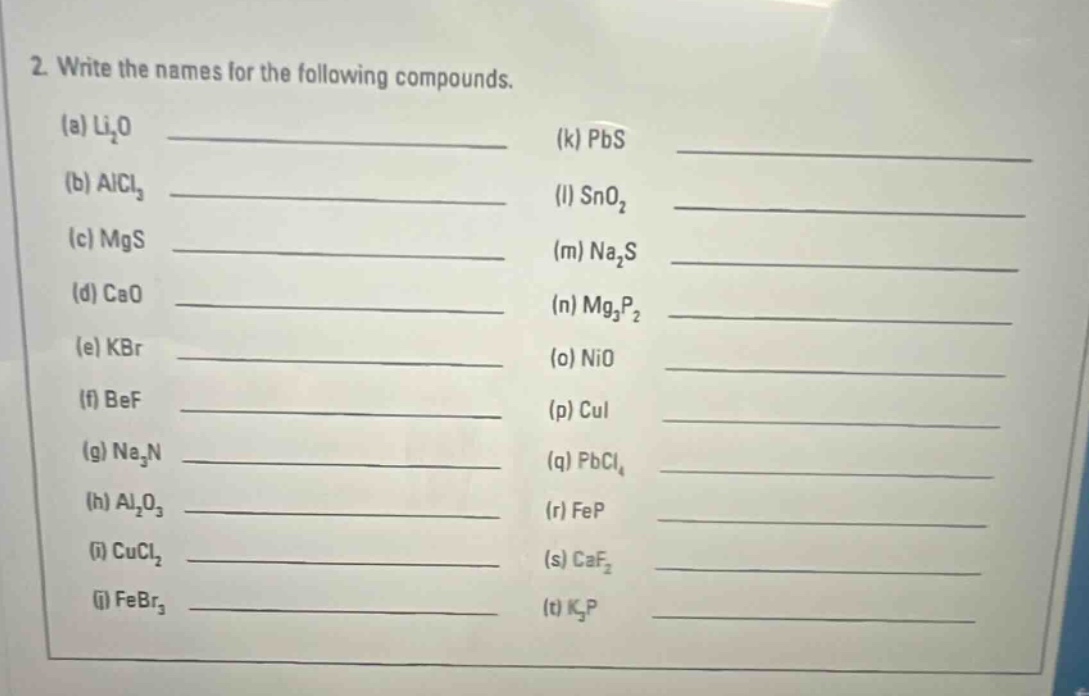
2. write the names for the following compounds.\n(a) li₂o ____________ (k) pbs ____________\n(b) alcl₃ ____________ (l) sno₂ ____________\n(c) mgs ____________ (m) na₂s ____________\n(d) cao ____________ (n) mg₃p₂ ____________\n(e) kbr ____________ (o) nio ____________\n(f) bef ____________ (p) cui ____________\n(g) na₃n ____________ (q) pbcl₄ ____________\n(h) al₂o₃ ____________ (r) fep ____________\n(i) cucl₂ ____________ (s) caf₂ ____________\n(j) febr₃ ____________ (t) k₃p ____________
Answer
Explanation:
Step1: Identify cation and anion
For ionic compounds, name the cation first followed by the anion. Use the element name for the cation and change the ending of the non - metal anion to “-ide”. For transition metals, use Roman numerals to indicate the charge if the metal has multiple oxidation states.
Step2: Name each compound
(a) $\text{Li}_2\text{O}$: Lithium is the cation and oxygen is the anion. Name is Lithium oxide. (b) $\text{AlCl}_3$: Aluminum is the cation and chlorine is the anion. Name is Aluminum chloride. (c) $\text{MgS}$: Magnesium is the cation and sulfur is the anion. Name is Magnesium sulfide. (d) $\text{CaO}$: Calcium is the cation and oxygen is the anion. Name is Calcium oxide. (e) $\text{KBr}$: Potassium is the cation and bromine is the anion. Name is Potassium bromide. (f) $\text{BeF}$ should be $\text{BeF}_2$. Beryllium is the cation and fluorine is the anion. Name is Beryllium fluoride. (g) $\text{Na}_3\text{N}$: Sodium is the cation and nitrogen is the anion. Name is Sodium nitride. (h) $\text{Al}_2\text{O}_3$: Aluminum is the cation and oxygen is the anion. Name is Aluminum oxide. (i) $\text{CuCl}_2$: Copper is a transition metal with a + 2 charge here. Name is Copper(II) chloride. (j) $\text{FeBr}_3$: Iron is a transition metal with a + 3 charge here. Name is Iron(III) bromide. (k) $\text{PbS}$: Lead is a transition metal with a + 2 charge here. Name is Lead(II) sulfide. (l) $\text{SnO}_2$: Tin is a transition metal with a + 4 charge here. Name is Tin(IV) oxide. (m) $\text{Na}_2\text{S}$: Sodium is the cation and sulfur is the anion. Name is Sodium sulfide. (n) $\text{Mg}_3\text{P}_2$: Magnesium is the cation and phosphorus is the anion. Name is Magnesium phosphide. (o) $\text{NiO}$: Nickel is a transition metal with a + 2 charge here. Name is Nickel(II) oxide. (p) $\text{CuI}$: Copper is a transition metal with a + 1 charge here. Name is Copper(I) iodide. (q) $\text{PbCl}_4$: Lead is a transition metal with a + 4 charge here. Name is Lead(IV) chloride. (r) $\text{FeP}$: Iron is a transition metal with a + 3 charge here. Name is Iron(III) phosphide. (s) $\text{CaF}_2$: Calcium is the cation and fluorine is the anion. Name is Calcium fluoride. (t) $\text{K}_3\text{P}$: Potassium is the cation and phosphorus is the anion. Name is Potassium phosphide.
Answer:
(a) Lithium oxide (b) Aluminum chloride (c) Magnesium sulfide (d) Calcium oxide (e) Potassium bromide (f) Beryllium fluoride (g) Sodium nitride (h) Aluminum oxide (i) Copper(II) chloride (j) Iron(III) bromide (k) Lead(II) sulfide (l) Tin(IV) oxide (m) Sodium sulfide (n) Magnesium phosphide (o) Nickel(II) oxide (p) Copper(I) iodide (q) Lead(IV) chloride (r) Iron(III) phosphide (s) Calcium fluoride (t) Potassium phosphide