write out in words the name of each of the following compounds:\ncucl2\nli3p\nfeo\nbai2\nna3n\ncsbr\nsns\nca3…
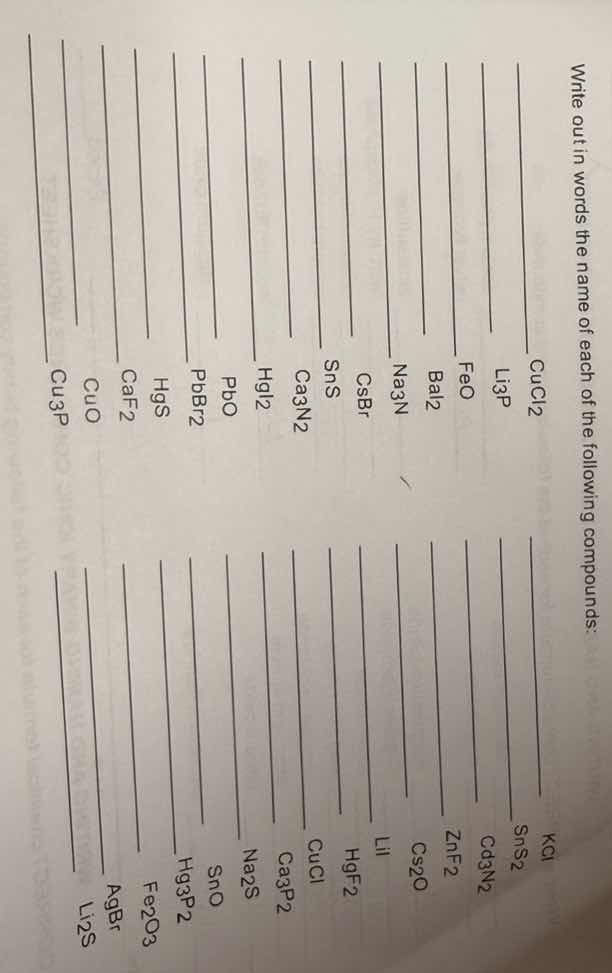
write out in words the name of each of the following compounds:\ncucl2\nli3p\nfeo\nbai2\nna3n\ncsbr\nsns\nca3n2\nhgi2\npbo\npbbr2\nhgs\ncaf2\ncuo\ncu3p\nkcl\nsns2\ncd3n2\nznf2\ncs2o\nlii\nhgf2\ncucl\nca3p2\nna2s\nsno\nhg3p2\nfe2o3\nagbr\nli2s
Answer
Brief Explanations:
These are ionic or binary covalent compounds. For metal-nonmetal compounds, name the metal first, then the nonmetal with an -ide suffix. For transition metals, include the charge in Roman numerals. For group 1/2 metals, use fixed charges. For nonmetal-nonmetal compounds, use prefixes (not needed here as most are ionic).
Answer:
- CuCl₂: Copper(II) chloride
- Li₃P: Lithium phosphide
- FeO: Iron(II) oxide
- BaI₂: Barium iodide
- Na₃N: Sodium nitride
- CsBr: Cesium bromide
- SnS: Tin(II) sulfide
- Ca₃N₂: Calcium nitride
- HgI₂: Mercury(II) iodide
- PbO: Lead(II) oxide
- PbBr₂: Lead(II) bromide
- HgS: Mercury(II) sulfide
- CaF₂: Calcium fluoride
- CuO: Copper(II) oxide
- Cu₃P: Copper(I) phosphide
- KCl: Potassium chloride
- SnS₂: Tin(IV) sulfide
- Cd₃N₂: Cadmium nitride
- ZnF₂: Zinc fluoride
- Cs₂O: Cesium oxide
- LiI: Lithium iodide
- HgF₂: Mercury(II) fluoride
- CuCl: Copper(I) chloride
- Ca₃P₂: Calcium phosphide
- Na₂S: Sodium sulfide
- SnO: Tin(II) oxide
- Hg₃P₂: Mercury(I) phosphide
- Fe₂O₃: Iron(III) oxide
- AgBr: Silver bromide
- Li₂S: Lithium sulfide