xv. may 8, 2025\na. how is the vsepr theory used to classify molecules?\nb. use vsepr theory to predict the…
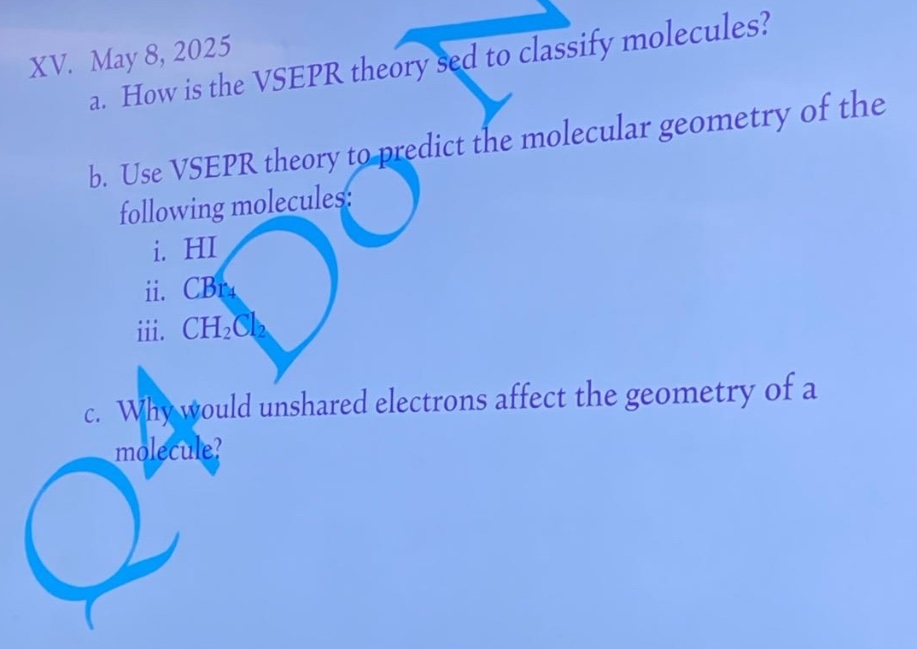
xv. may 8, 2025\na. how is the vsepr theory used to classify molecules?\nb. use vsepr theory to predict the molecular geometry of the following molecules:\ni. hi\nii. cbr₄\niii. ch₂cl₂\nc. why would unshared electrons affect the geometry of a molecule?
Answer
Explanation:
Step1: Explain VSEPR theory classification
VSEPR theory classifies molecules based on the repulsion between electron - groups (bonding and non - bonding) around the central atom. The electron - groups arrange themselves to minimize repulsion, determining the molecular geometry.
Step2: Predict geometry of HI
HI has a central atom (H) with one bonding pair and no lone pairs. According to VSEPR, it has a linear geometry.
Step3: Predict geometry of CBr₄
In CBr₄, the central C atom has 4 bonding pairs and no lone pairs. The electron - group geometry and molecular geometry are tetrahedral.
Step4: Predict geometry of CH₂Cl₂
For CH₂Cl₂, the central C atom has 4 bonding pairs and no lone pairs. Its molecular geometry is tetrahedral.
Step5: Explain effect of unshared electrons
Unshared (lone) electrons have a greater repulsion than bonding electrons. They occupy more space around the central atom, which pushes the bonding pairs closer together, thus affecting the molecular geometry.
Answer:
a. VSEPR theory classifies molecules based on electron - group repulsion around the central atom to minimize repulsion and determine geometry. b. i. Linear. ii. Tetrahedral. iii. Tetrahedral. c. Unshared electrons have greater repulsion and occupy more space, pushing bonding pairs and affecting molecular geometry.