6. as you adjust the number of protons, neutrons, and electrons pay attention to the atomic mass. based on…
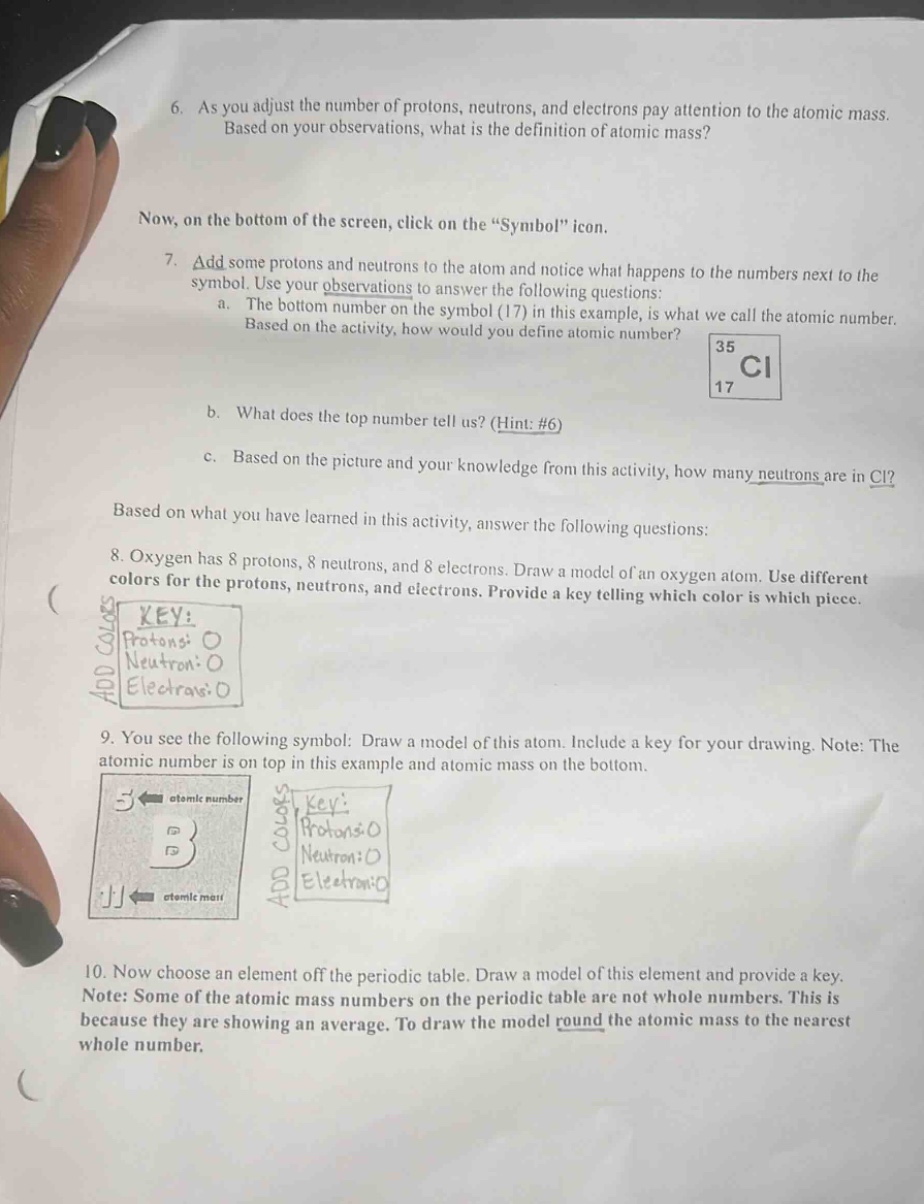
6. as you adjust the number of protons, neutrons, and electrons pay attention to the atomic mass. based on your observations, what is the definition of atomic mass? now, on the bottom of the screen, click on the “symbol” icon. 7. add some protons and neutrons to the atom and notice what happens to the numbers next to the symbol. use your observations to answer the following questions: a. the bottom number on the symbol (17) in this example, is what we call the atomic number. based on the activity, how would you define atomic number? b. what does the top number tell us? (hint: #6) c. based on the picture and your knowledge from this activity, how many neutrons are in cl? based on what you have learned in this activity, answer the following questions: 8. oxygen has 8 protons, 8 neutrons, and 8 electrons. draw a model of an oxygen atom. use different colors for the protons, neutrons, and electrons. provide a key telling which color is which piece. 9. you see the following symbol: draw a model of this atom. include a key for your drawing. note: the atomic number is on top in this example and atomic mass on the bottom. 10. now choose an element off the periodic table. draw a model of this element and provide a key. note: some of the atomic mass numbers on the periodic table are not whole numbers. this is because they are showing an average. to draw the model round the atomic mass to the nearest whole number.
Answer
Explanation:
Step1: Define atomic mass
Atomic mass is the sum of protons and neutrons in an atom.
Step2: Define atomic number
Atomic number is the number of protons in an atom.
Step3: Interpret top - number in symbol
The top number in the symbol ($^{35}_{17}Cl$) is the atomic mass, which is the sum of protons and neutrons.
Step4: Calculate neutrons in Cl
Number of neutrons = Atomic mass - Atomic number. For Cl, atomic mass = 35, atomic number = 17. So, number of neutrons = 35 - 17 = 18.
Step5: Draw oxygen atom model
Draw a nucleus. Place 8 red spheres (protons) and 8 blue spheres (neutrons) in the nucleus. Draw 8 green spheres (electrons) in electron - shells around the nucleus. Key: Red - Protons, Blue - Neutrons, Green - Electrons.
Step6: Draw boron atom model
For boron ($^{5}_{11}B$), draw a nucleus. Place 5 red spheres (protons) and 6 blue spheres (neutrons) in the nucleus (since number of neutrons = 11 - 5 = 6). Draw 5 green spheres (electrons) in electron - shells around the nucleus. Key: Red - Protons, Blue - Neutrons, Green - Electrons.
Step7: Draw chosen element model
Let's say we choose carbon ($^{6}_{12}C$). Draw a nucleus. Place 6 red spheres (protons) and 6 blue spheres (neutrons) in the nucleus. Draw 6 green spheres (electrons) in electron - shells around the nucleus. Key: Red - Protons, Blue - Neutrons, Green - Electrons.
Answer:
Atomic mass: Sum of protons and neutrons in an atom. Atomic number: Number of protons in an atom. Neutrons in Cl: 18. Oxygen atom model: As described above with key. Boron atom model: As described above with key. Chosen element (carbon) model: As described above with key.