you are given the reaction cu + hno₃ → cu(no₃)₂ + no + h₂o. half - reactions: 3cu → 3cu²⁺ + 6e⁻ 2n⁵⁺ + 6e⁻ →…
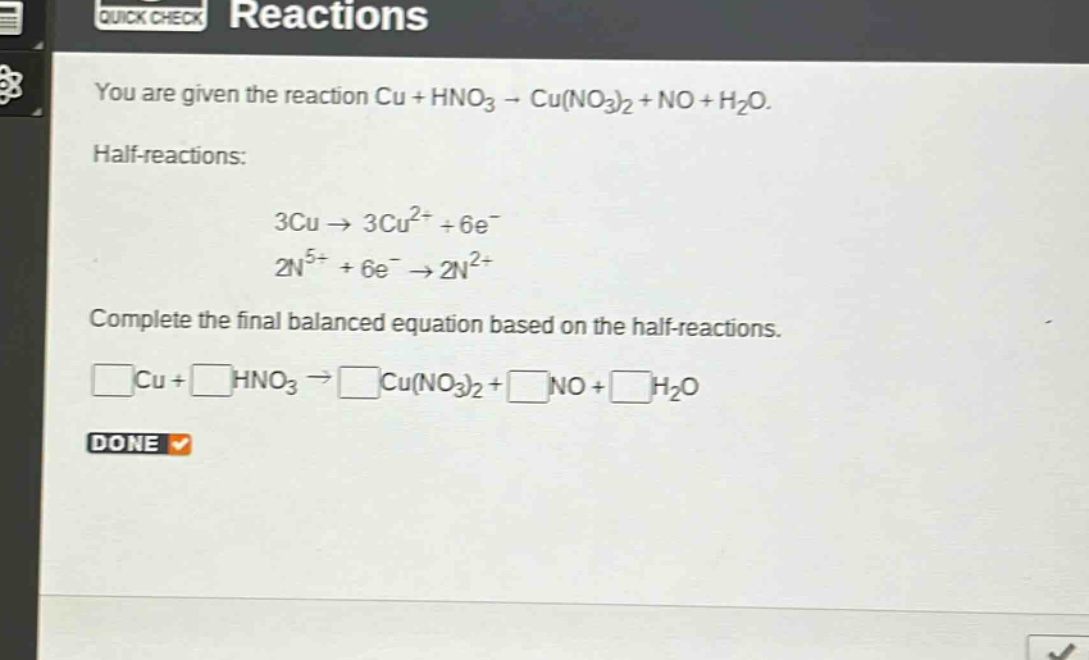
you are given the reaction cu + hno₃ → cu(no₃)₂ + no + h₂o. half - reactions: 3cu → 3cu²⁺ + 6e⁻ 2n⁵⁺ + 6e⁻ → 2n²⁺ complete the final balanced equation based on the half - reactions. □cu+□hno₃→□cu(no₃)₂+□no+□h₂o
Answer
Explanation:
Step1: Combine half - reactions
The oxidation half - reaction is $3Cu\rightarrow3Cu^{2 +}+6e^{-}$ and the reduction half - reaction is $2N^{5 +}+6e^{-}\rightarrow2N^{2 +}$. Combining them gives $3Cu + 2N^{5+}\rightarrow3Cu^{2 +}+2N^{2 +}$.
Step2: Rewrite in terms of compounds
In the original reaction, $N^{5+}$ is from $HNO_3$ and $N^{2+}$ is $NO$. Also, for every $Cu$ that reacts to form $Cu(NO_3)_2$, we need 2 moles of $NO_3^-$ from $HNO_3$. The $3Cu$ will form $3Cu(NO_3)_2$, which requires 6 moles of $NO_3^-$ from $HNO_3$. And we have 2 moles of $NO$ from the reduction. For the hydrogen and oxygen balance, we find that we need 4 moles of $HNO_3$ in total to balance the reaction. And we get 2 moles of $H_2O$.
Step3: Write the balanced equation
$3Cu + 8HNO_3\rightarrow3Cu(NO_3)_2+2NO + 4H_2O$
Answer:
$3Cu + 8HNO_3\rightarrow3Cu(NO_3)_2+2NO + 4H_2O$