3. what is your experimental r if you take into account the vapor pressure of water? (use the table below)…
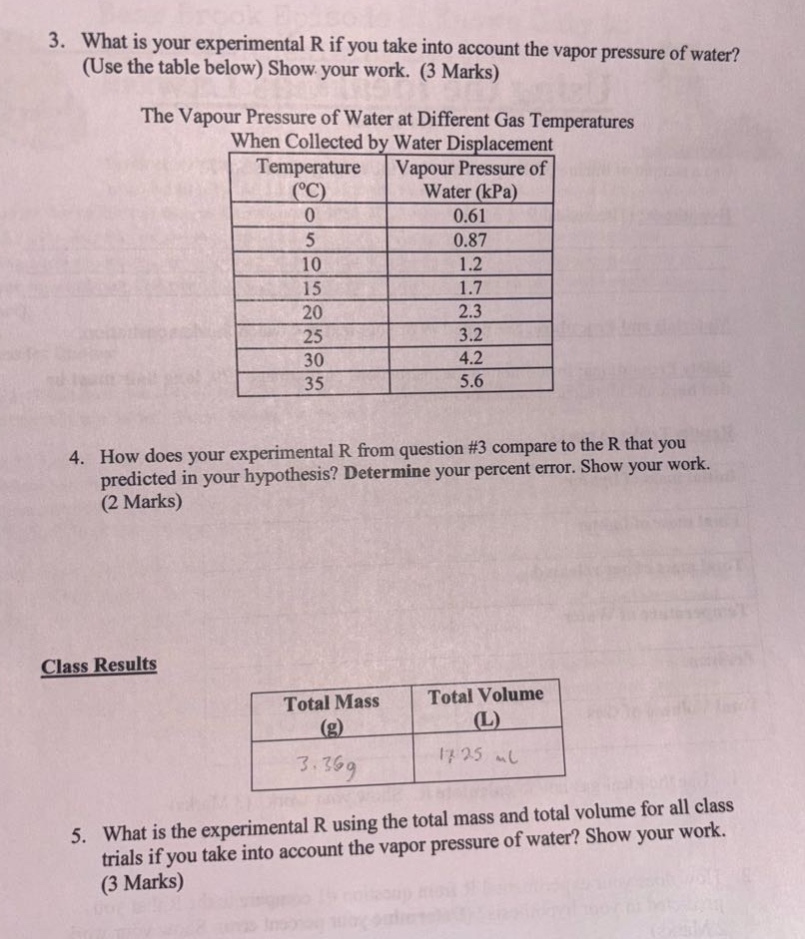
3. what is your experimental r if you take into account the vapor pressure of water? (use the table below) show your work. (3 marks)\nthe vapour pressure of water at different gas temperatures when collected by water displacement\n| temperature (°c) | vapour pressure of water (kpa) |\n| ---- | ---- |\n| 0 | 0.61 |\n| 5 | 0.87 |\n| 10 | 1.2 |\n| 15 | 1.7 |\n| 20 | 2.3 |\n| 25 | 3.2 |\n| 30 | 4.2 |\n| 35 | 5.6 |\n4. how does your experimental r from question #3 compare to the r that you predicted in your hypothesis? determine your percent error. show your work. (2 marks)\nclass results\n| total mass (g) | total volume (l) |\n| ---- | ---- |\n| 3.36g | 17.25 l |\n5. what is the experimental r using the total mass and total volume for all class trials if you take into account the vapor pressure of water? show your work. (3 marks)
Answer
Since the problem involves gas - related calculations and taking into account vapor pressure of water (a concept in physical chemistry), and requires calculations for the gas constant $R$, we will use the Step - by - Step Format.
However, the problem is incomplete as we are not given the temperature (needed to get the vapor pressure of water from the table), pressure, number of moles of the gas etc. to calculate the experimental $R$.
So the response is: "Sorry, the text provided is not valid. Please provide more details or clarify your question so I can assist you better."