will is 30 years old and works for a company that matches his 401(k) contribution up to 3%. the interest…
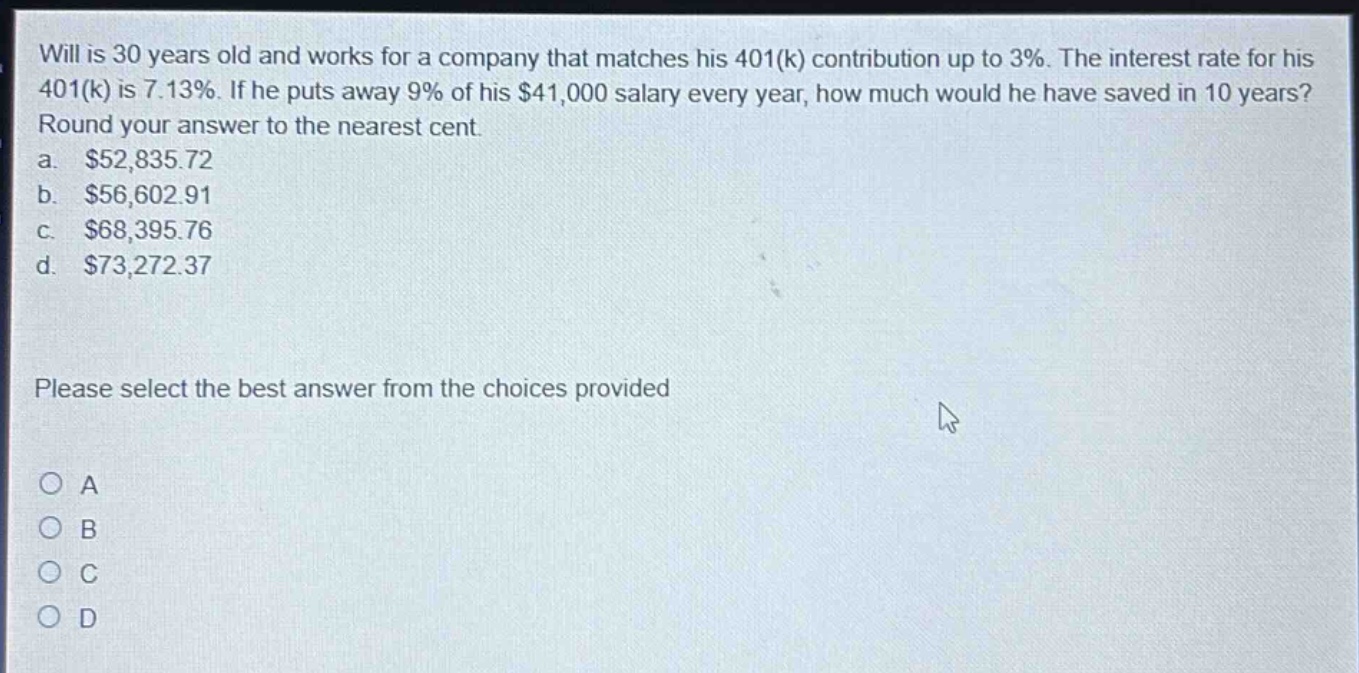
will is 30 years old and works for a company that matches his 401(k) contribution up to 3%. the interest rate for his 401(k) is 7.13%. if he puts away 9% of his $41,000 salary every year, how much would he have saved in 10 years? round your answer to the nearest cent. a. $52,835.72 b. $56,602.91 c. $68,395.76 d. $73,272.37 please select the best answer from the choices provided a b c d
Answer
Answer:
D. $73,272.37
Explanation:
Step1: Calcular la contribución anual
La contribución de Will es el 9% de su salario de $41,000. Entonces, $41000\times0.09 = 3690$. La empresa contribuye el 3% de su salario, es decir, $41000\times0.03=1230$. La contribución total anual $P = 3690 + 1230=4920$.
Step2: Aplicar la fórmula de valor futuro de una serie
La fórmula para el valor futuro de una serie (anualidad) es $FV = P\times\frac{(1 + r)^{n}-1}{r}$, donde $P$ es la contribución anual, $r$ es la tasa de interés anual (en decimal) y $n$ es el número de períodos. Aquí, $r = 0.0713$ y $n = 10$. $FV=4920\times\frac{(1 + 0.0713)^{10}-1}{0.0713}$.
Step3: Calcular $(1 + 0.0713)^{10}$
$(1 + 0.0713)^{10}\approx1.98015$.
Step4: Calcular $(1 + 0.0713)^{10}-1$
$1.98015-1 = 0.98015$.
Step5: Calcular $\frac{(1 + 0.0713)^{10}-1}{0.0713}$
$\frac{0.98015}{0.0713}\approx13.747$.
Step6: Calcular el valor futuro
$FV = 4920\times13.747\approx73272.37$.