adita has two options for how to invest $1,000. plan a: put the $1,000 in an account that pays $100 per…
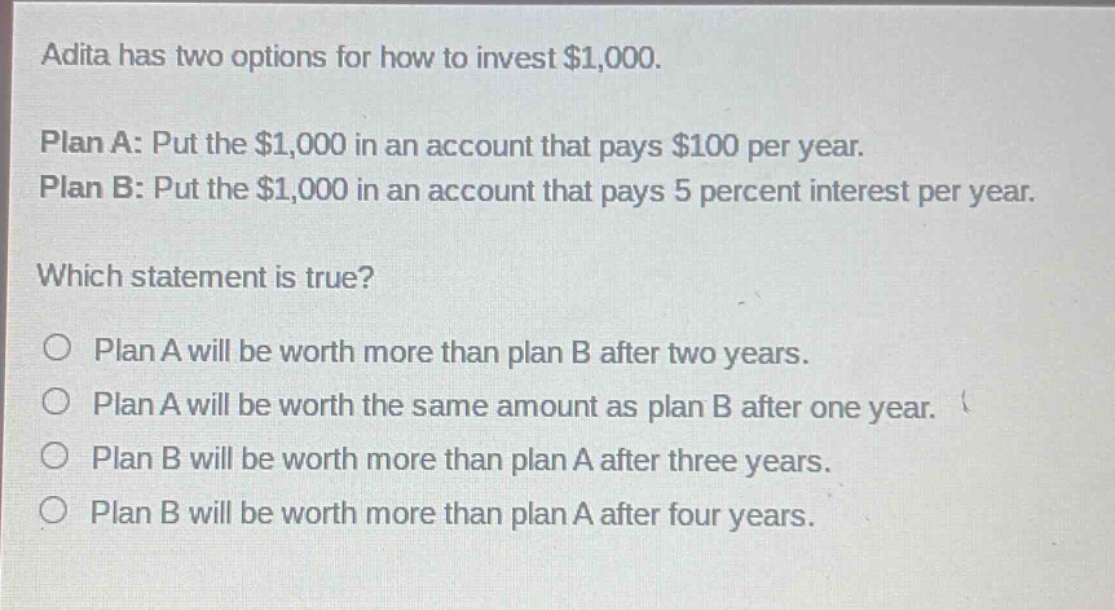
adita has two options for how to invest $1,000. plan a: put the $1,000 in an account that pays $100 per year. plan b: put the $1,000 in an account that pays 5 percent interest per year. which statement is true? o plan a will be worth more than plan b after two years. o plan a will be worth the same amount as plan b after one year. o plan b will be worth more than plan a after three years. o plan b will be worth more than plan a after four years.
Answer
Answer:
Plan B will be worth more than plan A after three years.
Explanation:
Step1: Calculate value of Plan A after n years
The value $V_A$ of Plan A after $n$ years with an initial investment of $P = 1000$ and an annual gain of $g=100$ is given by the formula $V_A=1000 + 100n$.
Step2: Calculate value of Plan B after n years
The value $V_B$ of Plan B after $n$ years with an initial investment of $P = 1000$ and an annual - interest rate $r = 0.05$ (5% expressed as a decimal) using the simple - interest formula $V=P(1 + rn)$ is $V_B=1000(1 + 0.05n)$.
Step3: Check after 1 year
For $n = 1$: $V_A=1000+100\times1=1100$ $V_B=1000(1 + 0.05\times1)=1000\times1.05 = 1050$ $V_A>V_B$
Step4: Check after 2 years
For $n = 2$: $V_A=1000+100\times2=1200$ $V_B=1000(1 + 0.05\times2)=1000\times1.1 = 1100$ $V_A>V_B$
Step5: Check after 3 years
For $n = 3$: $V_A=1000+100\times3=1300$ $V_B=1000(1 + 0.05\times3)=1000\times1.15 = 1150$ $V_B<V_A$
Step6: Check after 4 years
For $n = 4$: $V_A=1000+100\times4=1400$ $V_B=1000(1 + 0.05\times4)=1000\times1.2 = 1200$ $V_B<V_A$
So the statement "Plan B will be worth more than plan A after three years" is true.