anish is comparing two long - term investment options. option a is shown in the graph and option b is shown…
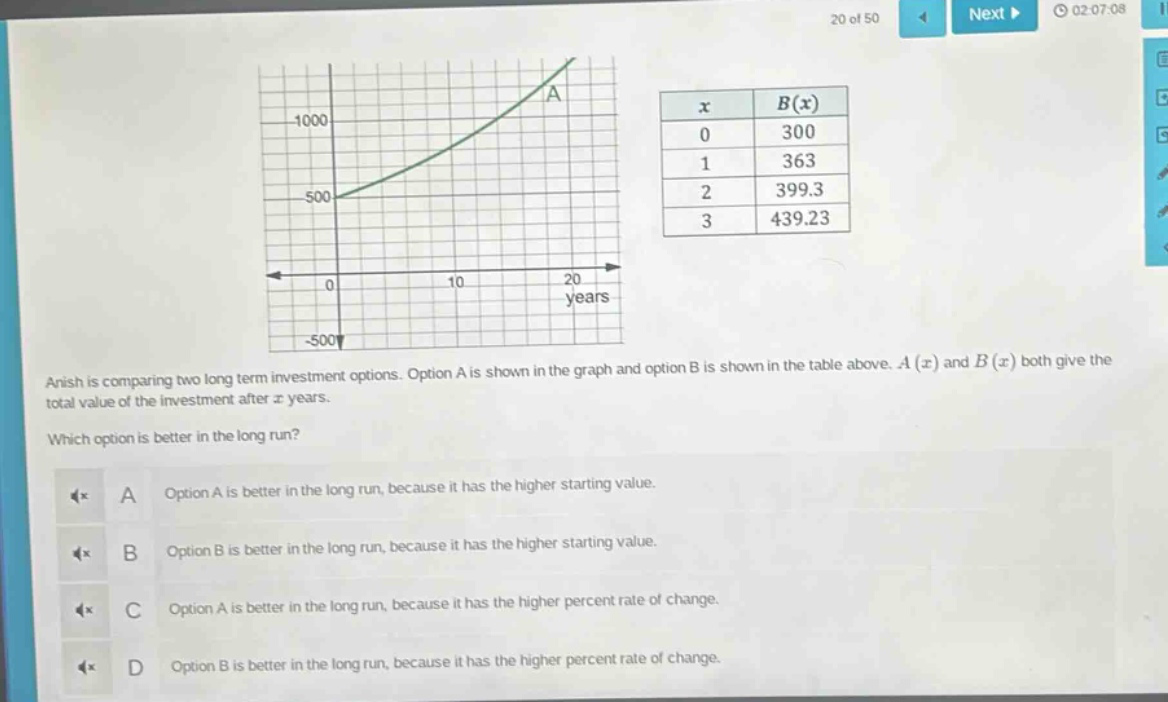
anish is comparing two long - term investment options. option a is shown in the graph and option b is shown in the table above. (a(x)) and (b(x)) both give the total value of the investment after (x) years. which option is better in the long run? a option a is better in the long run, because it has the higher starting value. b option b is better in the long run, because it has the higher starting value. c option a is better in the long run, because it has the higher percent rate of change. d option b is better in the long run, because it has the higher percent rate of change.
Answer
Answer:
D. Option B is better in the long run, because it has the higher percent rate of change.
Explanation:
Step1: Find starting - values
For option A, starting value (at (x = 0)) is (500). For option B, starting value (at (x=0)) is (300), so starting - value is not the determining factor.
Step2: Calculate percent rate of change for option B
The percent rate of change formula is (r=\frac{B(x + 1)-B(x)}{B(x)}). For (x = 0), (r=\frac{363 - 300}{300}=\frac{63}{300}=0.21 = 21%).
Step3: Analyze option A
Option A appears to be a linear function (from the graph). A linear function has a constant rate of change (slope), and its rate of change is less than the exponential - like growth of option B (since exponential functions with (r> 1) grow faster than linear functions in the long run). So option B has a higher percent rate of change and is better in the long run.