a bakery plans on borrowing money to buy a new van.\n- the interest rate on the money borrowed is 5.2% per…
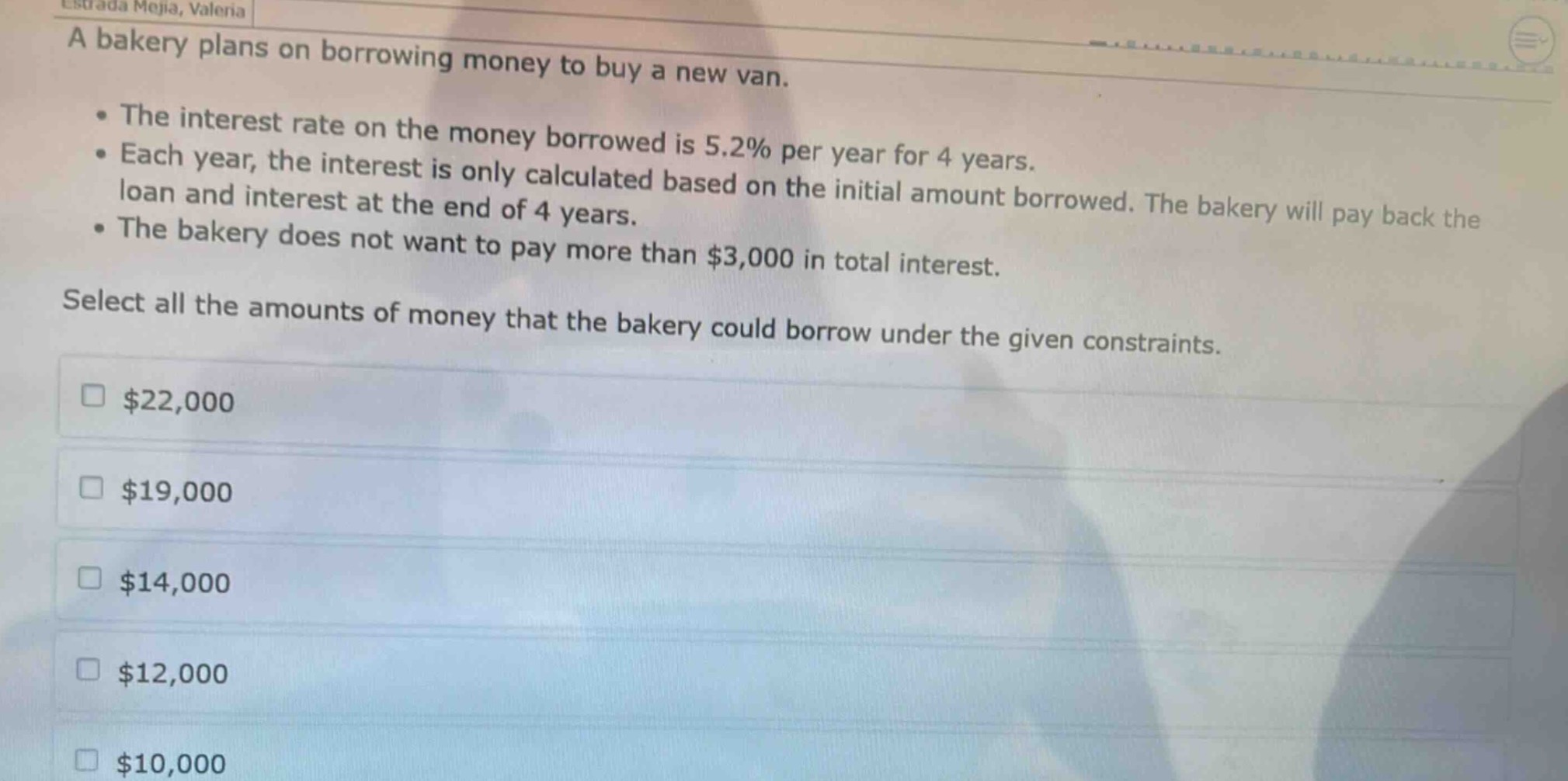
a bakery plans on borrowing money to buy a new van.\n- the interest rate on the money borrowed is 5.2% per year for 4 years.\n- each year, the interest is only calculated based on the initial amount borrowed. the bakery will pay back the loan and interest at the end of 4 years.\n- the bakery does not want to pay more than $3,000 in total interest.\nselect all the amounts of money that the bakery could borrow under the given constraints.\n$22,000\n$19,000\n$14,000\n$12,000\n$10,000
Answer
Explanation:
Step1: Recall simple - interest formula
The simple - interest formula is $I = Prt$, where $I$ is the interest, $P$ is the principal amount (the amount borrowed), $r$ is the annual interest rate (as a decimal), and $t$ is the time in years. Given $r = 0.052$ and $t = 4$.
Step2: Substitute values into formula
We get $I=P\times0.052\times4 = 0.208P$.
Step3: Set up inequality
The bakery does not want to pay more than $I = 3000$ in interest. So, $0.208P\leq3000$.
Step4: Solve for $P$
Dividing both sides of the inequality by $0.208$, we have $P\leq\frac{3000}{0.208}\approx14423.08$.
Answer:
$19000$: No $14000$: Yes $12000$: Yes $10000$: Yes $22000$: No So the amounts are $$19,000$ (No), $$14,000$ (Yes), $$12,000$ (Yes), $$10,000$ (Yes), $$22,000$ (No). The selected amounts are $$14,000$, $$12,000$, $$10,000$.