bruce takes out a personal loan of $1,000 to go on a trip to florida. his loan has an annual compound…
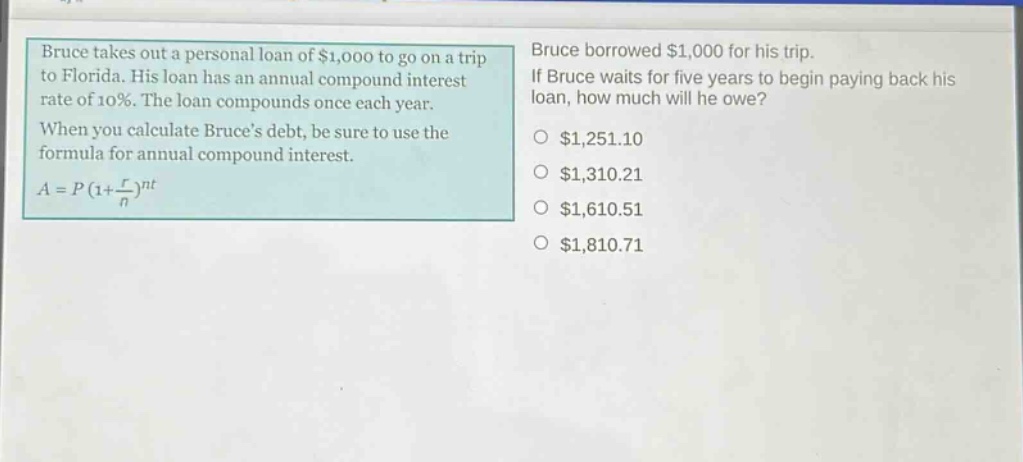
bruce takes out a personal loan of $1,000 to go on a trip to florida. his loan has an annual compound interest rate of 10%. the loan compounds once each year. when you calculate bruces debt, be sure to use the formula for annual compound interest. $a = p(1+\frac{r}{n})^{nt}$ bruce borrowed $1,000 for his trip. if bruce waits for five years to begin paying back his loan, how much will he owe? $1,251.10 $1,310.21 $1,610.51 $1,810.71
Answer
Explanation:
Step1: Identify values
$P = 1000$, $r=0.1$, $n = 1$, $t = 5$
Step2: Substitute into formula
$A=1000(1 +\frac{0.1}{1})^{1\times5}$
Step3: Calculate exponent part
$(1 + 0.1)^{5}=1.1^{5}=1.61051$
Step4: Calculate final amount
$A = 1000\times1.61051=1610.51$
Answer:
$1,610.51$ (corresponds to option C if the options are numbered as A, B, C, D in order)