a business owner opens one store in town a. the equation p(x)=10,000(1.075)^t represents the anticipated…
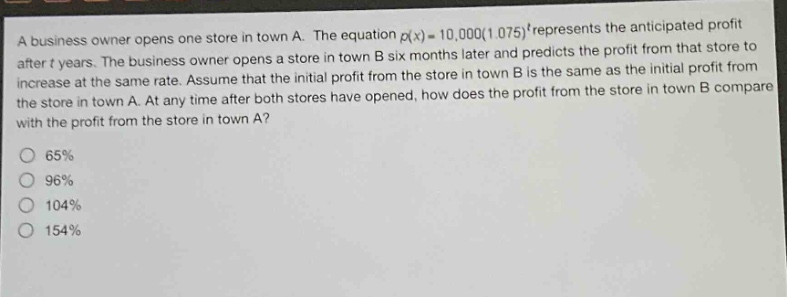
a business owner opens one store in town a. the equation p(x)=10,000(1.075)^t represents the anticipated profit after t years. the business owner opens a store in town b six months later and predicts the profit from that store to increase at the same rate. assume that the initial profit from the store in town b is the same as the initial profit from the store in town a. at any time after both stores have opened, how does the profit from the store in town b compare with the profit from the store in town a? 65% 96% 104% 154%
Answer
Explanation:
Step1: Define profit functions
Let $t$ be the number of years since the store in town A opened. The profit of store A is $P_A(t)=10000(1.075)^t$. The store in town B opened 0.5 years later, so the profit of store B is $P_B(t)=10000(1.075)^{t - 0.5}$.
Step2: Find the ratio
We want to find $\frac{P_B(t)}{P_A(t)}$. Substitute the functions: $\frac{P_B(t)}{P_A(t)}=\frac{10000(1.075)^{t - 0.5}}{10000(1.075)^t}$.
Step3: Simplify the ratio
Using the exponent - rule $\frac{a^m}{a^n}=a^{m - n}$, we have $\frac{(1.075)^{t - 0.5}}{(1.075)^t}=(1.075)^{(t - 0.5)-t}=(1.075)^{- 0.5}=\frac{1}{\sqrt{1.075}}\approx0.96$.
Answer:
96%