when calculating the effective rate of a loan, which statement or statements must be true if n is greater…
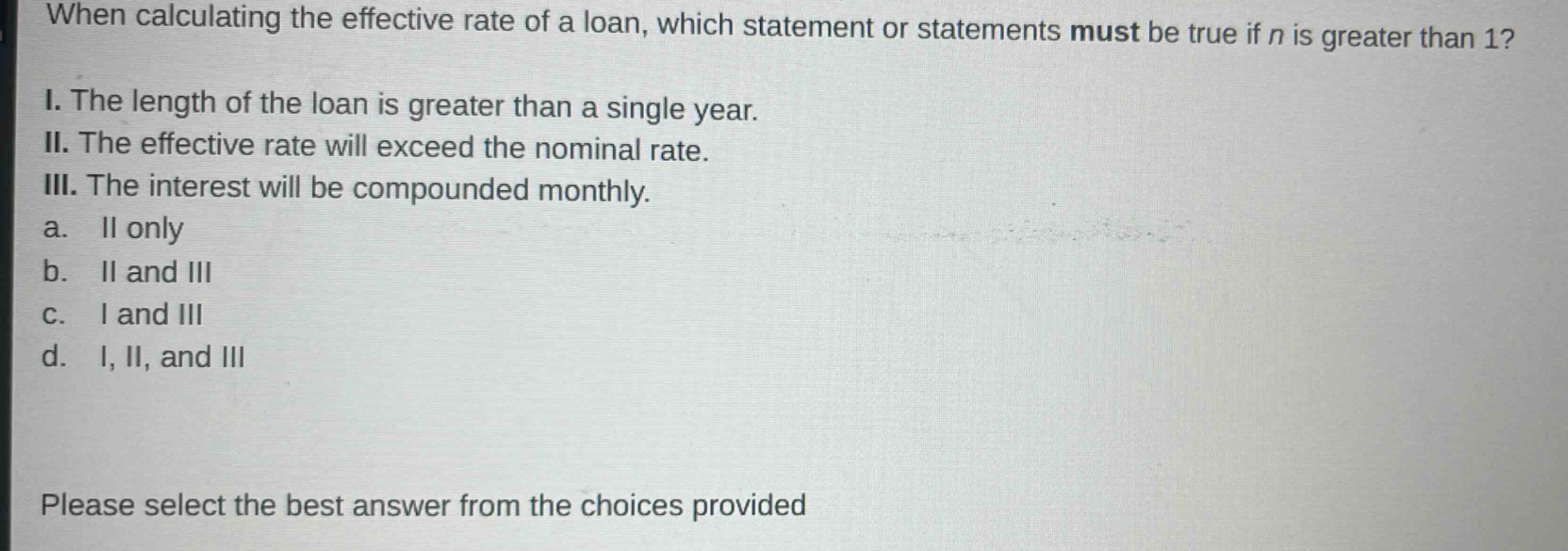
when calculating the effective rate of a loan, which statement or statements must be true if n is greater than 1? i. the length of the loan is greater than a single year. ii. the effective rate will exceed the nominal rate. iii. the interest will be compounded monthly. a. ii only b. ii and iii c. i and iii d. i, ii, and iii please select the best answer from the choices provided
Answer
Explanation:
Step1: Analyze statement I
$n$ represents the number of compound - ing periods per year, not loan length. So statement I is false.
Step2: Analyze statement II
The formula for the effective - annual - rate (EAR) is $EAR=(1 + \frac{r}{n})^{n}-1$, where $r$ is the nominal annual rate. When $n>1$, $(1+\frac{r}{n})^{n}>1 + r$ (by the binomial expansion or the property of compounding). So the effective rate will exceed the nominal rate. Statement II is true.
Step3: Analyze statement III
$n>1$ means compounding occurs more than once a year, but it doesn't have to be monthly. It could be quarterly ($n = 4$), semi - annually ($n=2$), etc. So statement III is false.
Answer:
A. II only