christine obrien, who is self - employed, wants to invest $70,000 in a pension plan. one investment offers…
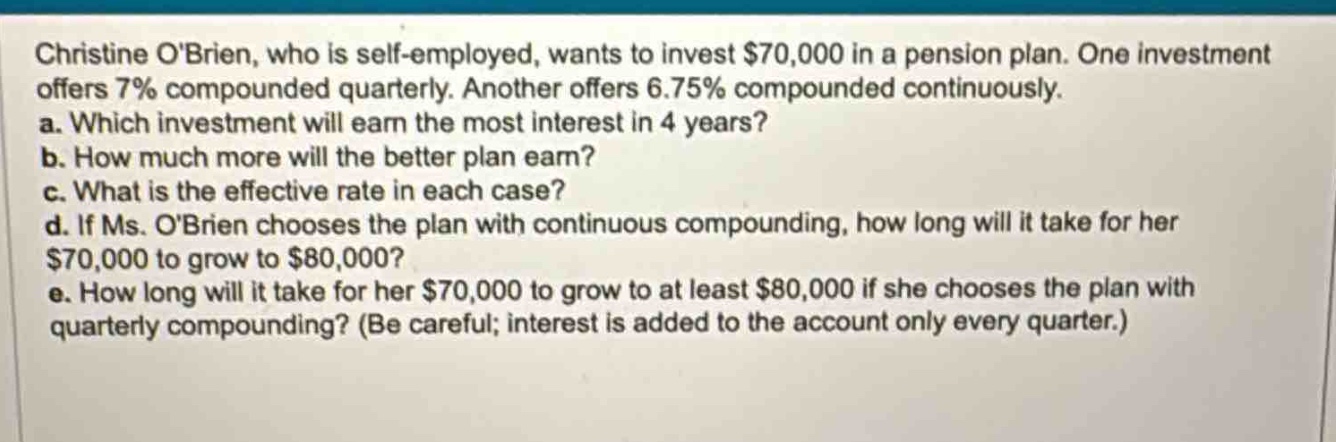
christine obrien, who is self - employed, wants to invest $70,000 in a pension plan. one investment offers 7% compounded quarterly. another offers 6.75% compounded continuously.\na. which investment will earn the most interest in 4 years?\nb. how much more will the better plan earn?\nc. what is the effective rate in each case?\nd. if ms. obrien chooses the plan with continuous compounding, how long will it take for her $70,000 to grow to $80,000?\ne. how long will it take for her $70,000 to grow to at least $80,000 if she chooses the plan with quarterly compounding? (be careful; interest is added to the account only every quarter.)
Answer
Explanation:
Step1: Calculate future - value for 7% compounded quarterly
The compound - interest formula is $A = P(1+\frac{r}{n})^{nt}$, where $P=$70000$, $r = 0.07$, $n = 4$ (quarterly compounding), and $t = 4$. $A_1=70000(1 +\frac{0.07}{4})^{4\times4}=70000(1 + 0.0175)^{16}$ $A_1=70000\times1.0175^{16}\approx70000\times1.32129096\approx$92490.37$ Interest earned $I_1=A_1 - P=92490.37−70000=$22490.37$
Step2: Calculate future - value for 6.75% compounded continuously
The continuous - compounding formula is $A = Pe^{rt}$, where $P = 70000$, $r=0.0675$, and $t = 4$. $A_2=70000e^{0.0675\times4}=70000e^{0.27}$ $A_2\approx70000\times1.31001677\approx$91701.17$ Interest earned $I_2=A_2 - P=91701.17−70000=$21701.17$ Since $I_1>I_2$, the 7% compounded quarterly investment earns more interest.
Step3: Calculate the difference in interest
The difference in interest is $I_1 - I_2=22490.37−21701.17=$789.20$
Step4: Calculate the effective rate for 7% compounded quarterly
The effective - rate formula is $r_{eff}=(1+\frac{r}{n})^{n}-1$. For $r = 0.07$ and $n = 4$, $r_{eff1}=(1+\frac{0.07}{4})^{4}-1=(1 + 0.0175)^{4}-1$ $r_{eff1}=1.0175^{4}-1\approx1.071859 - 1=0.071859\approx7.19%$
Step5: Calculate the effective rate for 6.75% compounded continuously
The effective - rate formula for continuous compounding is $r_{eff}=e^{r}-1$. For $r = 0.0675$, $r_{eff2}=e^{0.0675}-1\approx1.07008 - 1=0.07008\approx7.01%$
Step6: Find the time for continuous compounding
We use the formula $A = Pe^{rt}$. Given $P = 70000$, $A = 80000$, and $r = 0.0675$. $80000=70000e^{0.0675t}$ $\frac{80000}{70000}=e^{0.0675t}$ $\frac{8}{7}=e^{0.0675t}$ Take the natural logarithm of both sides: $\ln(\frac{8}{7})=\ln(e^{0.0675t})$ Since $\ln(e^{x})=x$, we have $\ln(\frac{8}{7}) = 0.0675t$ $t=\frac{\ln(\frac{8}{7})}{0.0675}\approx\frac{0.13353}{0.0675}\approx1.98\approx2$ years
Step7: Find the time for quarterly compounding
We use the formula $A = P(1+\frac{r}{n})^{nt}$. Given $P = 70000$, $A\geq80000$, $r = 0.07$, and $n = 4$. $80000\leq70000(1+\frac{0.07}{4})^{4t}$ $\frac{80000}{70000}\leq(1 + 0.0175)^{4t}$ $\frac{8}{7}\leq1.0175^{4t}$ Take the natural logarithm of both sides: $\ln(\frac{8}{7})\leq\ln(1.0175^{4t})$ Since $\ln(a^{b})=b\ln(a)$, we have $\ln(\frac{8}{7})\leq4t\ln(1.0175)$ $t\geq\frac{\ln(\frac{8}{7})}{4\ln(1.0175)}$ $\ln(\frac{8}{7})\approx0.13353$, $\ln(1.0175)\approx0.01735$ $4\ln(1.0175)\approx0.0694$ $t\geq\frac{0.13353}{0.0694}\approx1.92$ years. Since interest is added quarterly, we need to round up to the next - quarter. So $t = 2$ years (8 quarters).
Answer:
a. The investment with 7% compounded quarterly. b. $$789.20$ c. 7.19% for 7% compounded quarterly; 7.01% for 6.75% compounded continuously. d. Approximately 2 years. e. 2 years (8 quarters).