comparing loans\nwhich statement best compares these two loans?\nloan a\tloan b\nloan amount\t$15,000\t$10,00…
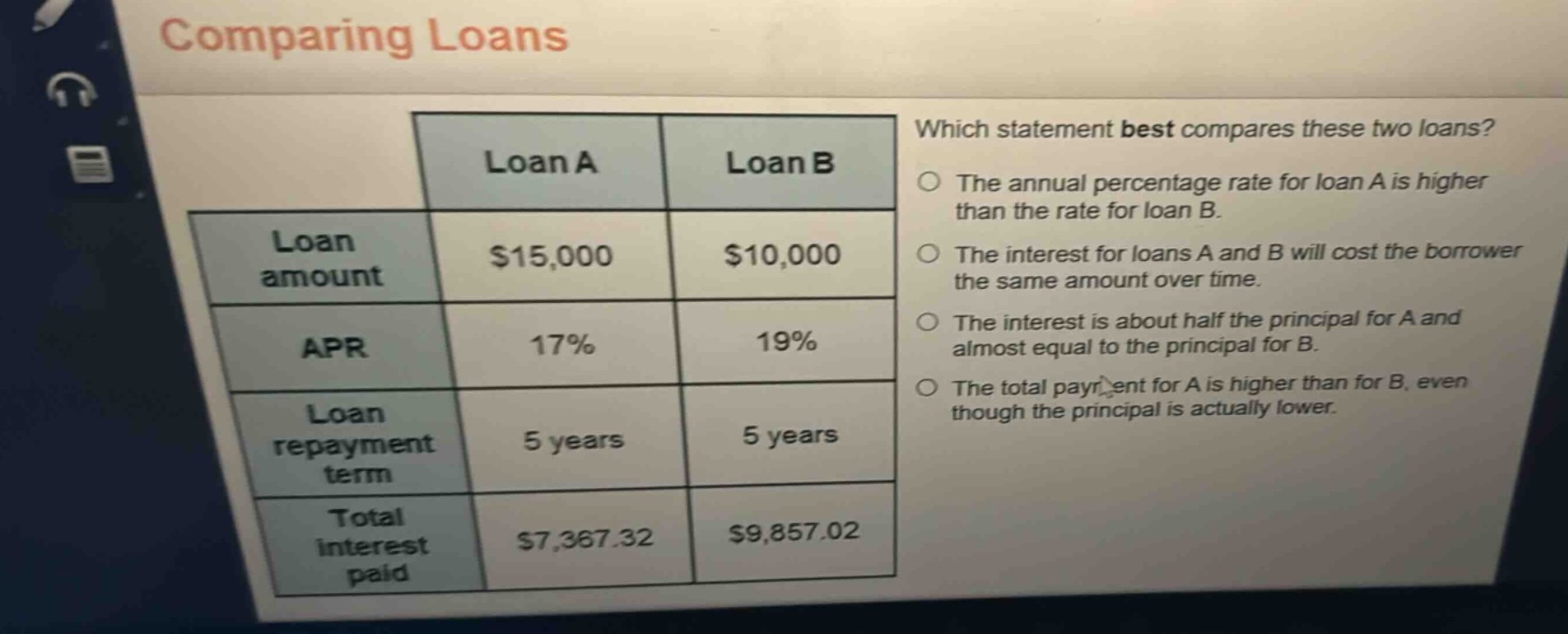
comparing loans\nwhich statement best compares these two loans?\nloan a\tloan b\nloan amount\t$15,000\t$10,000\napr\t17%\t19%\nloan repayment term\t5 years\t5 years\ntotal interest paid\t$7,367.32\t$9,857.02\nthe annual percentage rate for loan a is higher than the rate for loan b.\nthe interest for loans a and b will cost the borrower the same amount over time.\nthe interest is about half the principal for a and almost equal to the principal for b.\nthe total payment for a is higher than for b, even though the principal is actually lower.
Answer
Answer:
The annual percentage rate for loan A is higher than the rate for loan B.
Explanation:
Step1: Identify APR values
Loan A APR is 17%, Loan B APR is 19%.
Step2: Compare APR values
17% < 19%, so the statement "The annual percentage rate for loan A is higher than the rate for loan B" is false.
Step3: Analyze interest - cost statement
Interest for A is $7367.32 and for B is $9857.02, not the same, so "The interest for loans A and B will cost the borrower the same amount over time" is false.
Step4: Analyze interest - principal statement
For A, $\frac{7367.32}{15000}\approx0.491$ (not about half). For B, $\frac{9857.02}{10000} = 0.985702$ (not almost equal to principal), so "The interest is about half the principal for A and almost equal to the principal for B" is false.
Step5: Analyze total - payment statement
Loan A principal is $15000 and total interest is $7367.32, total payment is $15000 + 7367.32=22367.32$. Loan B principal is $10000 and total interest is $9857.02, total payment is $10000 + 9857.02 = 19857.02$. Total payment for A is higher and principal of A is higher, so "The total payment for A is higher than for B, even though the principal is actually lower" is false.