compound interest worksheet\n1.) you invested $52,400 at 6% compounded annually for 5 years. what is your…
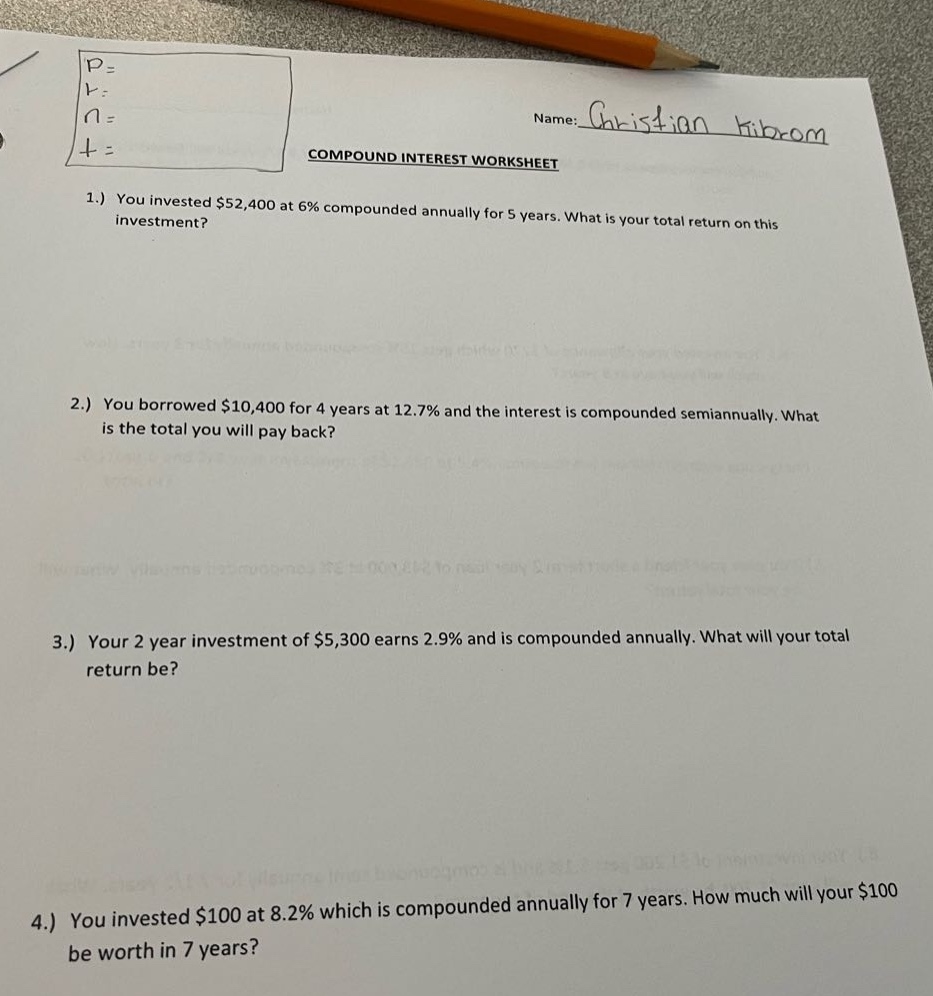
compound interest worksheet\n1.) you invested $52,400 at 6% compounded annually for 5 years. what is your total return on this investment?\n2.) you borrowed $10,400 for 4 years at 12.7% and the interest is compounded semiannually. what is the total you will pay back?\n3.) your 2 - year investment of $5,300 earns 2.9% and is compounded annually. what will your total return be?\n4.) you invested $100 at 8.2% which is compounded annually for 7 years. how much will your $100 be worth in 7 years?
Answer
1.
Explanation:
Step1: Identify compound - interest formula
The compound - interest formula is $A = P(1 + \frac{r}{n})^{nt}$, where $A$ is the final amount, $P$ is the principal amount, $r$ is the annual interest rate (in decimal), $n$ is the number of times interest is compounded per year, and $t$ is the number of years. Here, $P=$52400$, $r = 0.06$, $n = 1$, and $t = 5$. $A=52400\times(1+\frac{0.06}{1})^{1\times5}$
Step2: Calculate the value inside the parentheses
$1+\frac{0.06}{1}=1 + 0.06=1.06$
Step3: Calculate the exponent
$(1.06)^{5}=1.06\times1.06\times1.06\times1.06\times1.06\approx1.3382255776$
Step4: Calculate the final amount
$A = 52400\times1.3382255776\approx$70123.02$ The total return is $A - P=70123.02−52400=$17723.02$
2.
Explanation:
Step1: Identify values for the formula
$P = 10400$, $r=0.127$, $n = 2$ (semi - annual compounding), $t = 4$. $A=10400\times(1+\frac{0.127}{2})^{2\times4}$
Step2: Calculate the value inside the parentheses
$1+\frac{0.127}{2}=1 + 0.0635 = 1.0635$
Step3: Calculate the exponent
$(1.0635)^{8}=1.0635\times1.0635\times1.0635\times1.0635\times1.0635\times1.0635\times1.0635\times1.0635\approx1.612227$
Step4: Calculate the final amount
$A = 10400\times1.612227\approx$16767.16$
3.
Explanation:
Step1: Identify values for the formula
$P = 5300$, $r = 0.029$, $n = 1$, $t = 2$. $A=5300\times(1+\frac{0.029}{1})^{1\times2}$
Step2: Calculate the value inside the parentheses
$1+\frac{0.029}{1}=1.029$
Step3: Calculate the exponent
$(1.029)^{2}=1.029\times1.029 = 1.058841$
Step4: Calculate the final amount
$A=5300\times1.058841\approx$5611.86$ The total return is $A - P=5611.86−5300=$311.86$
4.
Explanation:
Step1: Identify values for the formula
$P = 100$, $r = 0.082$, $n = 1$, $t = 7$. $A=100\times(1+\frac{0.082}{1})^{1\times7}$
Step2: Calculate the value inside the parentheses
$1+\frac{0.082}{1}=1.082$
Step3: Calculate the exponent
$(1.082)^{7}=1.082\times1.082\times1.082\times1.082\times1.082\times1.082\times1.082\approx1.747257$
Step4: Calculate the final amount
$A = 100\times1.747257=$174.73$
Answer:
- Total return: $$17723.02$
- Total amount to pay back: $$16767.16$
- Total return: $$311.86$
- Final amount: $$174.73$