compounding quarterly: you deposit $25000 in a bank, which offers you .66% interest compounded quarterly…
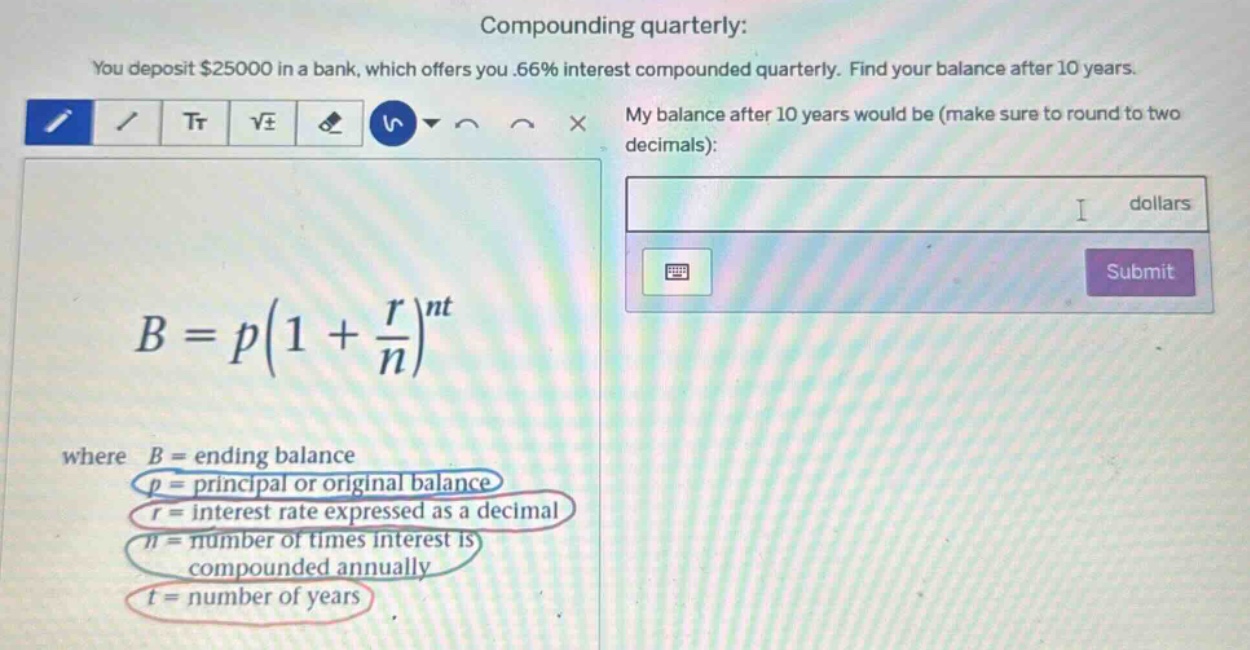
compounding quarterly: you deposit $25000 in a bank, which offers you .66% interest compounded quarterly. find your balance after 10 years. my balance after 10 years would be (make sure to round to two decimals): dollars b = p(1 + r/n)^nt where b = ending balance p = principal or original balance r = interest rate expressed as a decimal n = number of times interest is compounded annually t = number of years
Answer
Explanation:
Step1: Identify the values
$p = 25000$, $r=0.0066$ (since $0.66%=0.0066$), $n = 4$ (compounded quarterly), $t = 10$.
Step2: Substitute values into formula
$B=25000\left(1+\frac{0.0066}{4}\right)^{4\times10}$. First, calculate the value inside the parentheses: $\frac{0.0066}{4}=0.00165$, then $1 + 0.00165=1.00165$. And $4\times10 = 40$. So $B = 25000\times(1.00165)^{40}$.
Step3: Calculate the power
$(1.00165)^{40}\approx1.06817$.
Step4: Calculate the final balance
$B=25000\times1.06817 = 26704.25$.
Answer:
$26704.25$