consider a savings account earning annual compound interest with no additional deposits or withdrawals made…
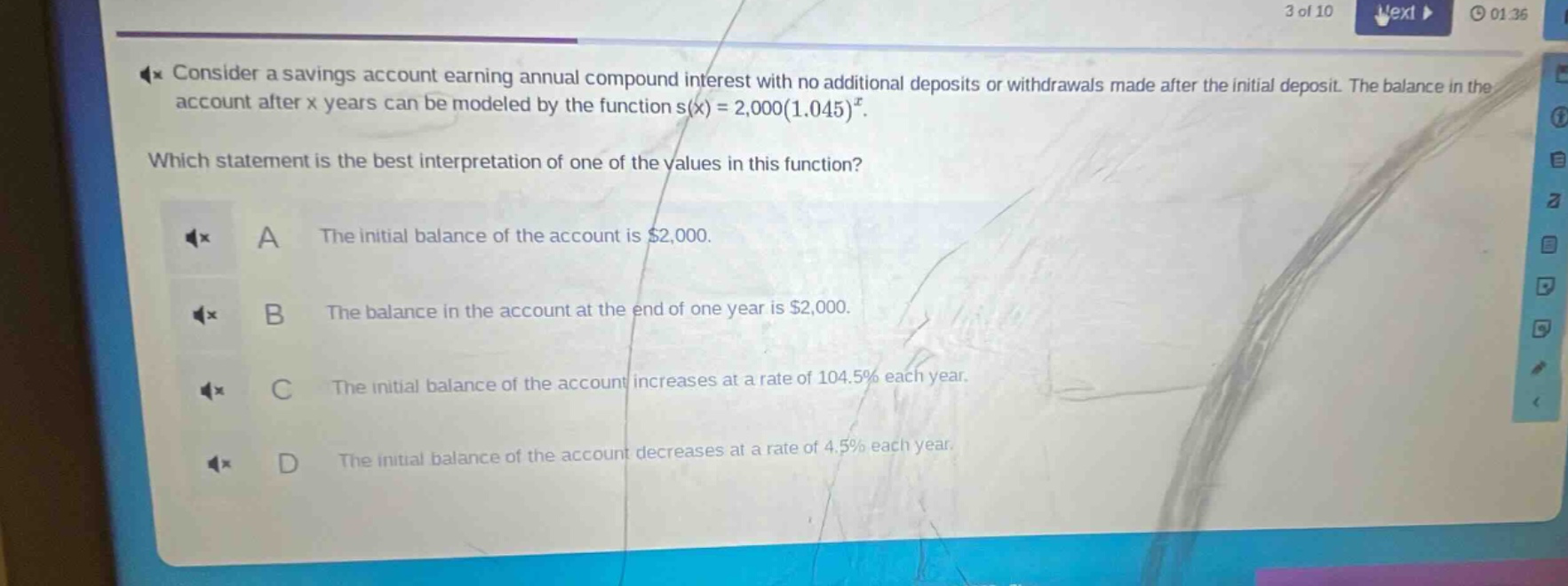
consider a savings account earning annual compound interest with no additional deposits or withdrawals made after the initial deposit. the balance in the account after x years can be modeled by the function s(x)=2,000(1.045)^x. which statement is the best interpretation of one of the values in this function? a the initial balance of the account is $2,000. b the balance in the account at the end of one year is $2,000. c the initial balance of the account increases at a rate of 104.5% each year. d the initial balance of the account decreases at a rate of 4.5% each year.
Answer
Explanation:
Step1: Recall compound - interest formula
The general compound - interest formula is $A = P(1 + r)^t$, where $P$ is the principal (initial amount), $r$ is the annual interest rate as a decimal, and $t$ is the number of years. In the given function $s(x)=2000(1.045)^x$, comparing with the general formula, when $x = 0$, $s(0)=2000(1.045)^0=2000$.
Step2: Analyze each option
- Option A: When $x = 0$ (at the start, before any time has passed), $s(0)=2000$, so the initial balance of the account is $2000$. This is correct.
- Option B: When $x = 1$, $s(1)=2000\times1.045 = 2090\neq2000$. So this is incorrect.
- Option C: The growth factor is $1.045$, which means the balance increases at a rate of $4.5%$ each year ($1.045=1 + 0.045$, where $0.045$ is the interest rate as a decimal), not $104.5%$. So this is incorrect.
- Option D: The balance is increasing since the growth factor $1.045>1$, not decreasing. So this is incorrect.
Answer:
A. The initial balance of the account is $2,000.