a customer deposits $1,000 in an account in which the interest is compounded annually. the table below shows…
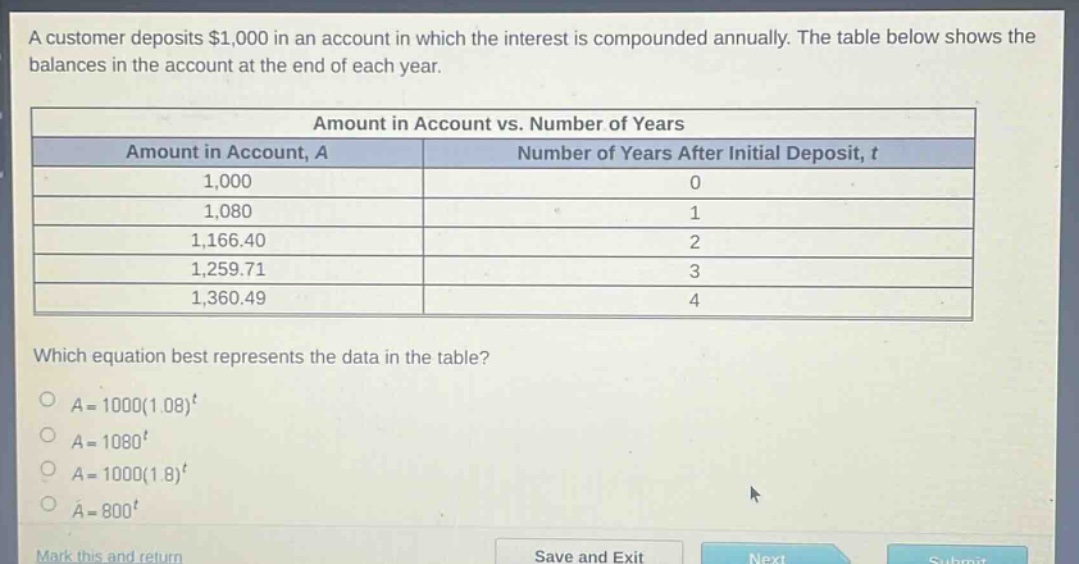
a customer deposits $1,000 in an account in which the interest is compounded annually. the table below shows the balances in the account at the end of each year.\n\n| amount in account vs. number of years | |\n|--|--|--|\n| amount in account, a | number of years after initial deposit, t |\n| 1,000 | 0 |\n| 1,080 | 1 |\n| 1,166.40 | 2 |\n| 1,259.71 | 3 |\n| 1,360.49 | 4 |\n\nwhich equation best represents the data in the table?\n\n$a = 1000(1.08)^t$\n$a = 1080^t$\n$a = 1000(1.8)^t$\n$a = 800^t$
Answer
Explanation:
Step1: Recall compound - interest formula
The compound - interest formula when compounded annually is $A = P(1 + r)^t$, where $P$ is the principal amount, $r$ is the annual interest rate, $t$ is the number of years, and $A$ is the amount in the account after $t$ years. Here, $P=$1000$.
Step2: Find the interest rate
When $t = 1$, $A=1080$ and $P = 1000$. Substitute into $A = P(1 + r)^t$: $1080=1000(1 + r)^1$. Then $\frac{1080}{1000}=1 + r$, so $1 + r=1.08$.
Step3: Determine the equation
Since $P = 1000$ and $1 + r=1.08$, the equation for the amount $A$ in the account after $t$ years is $A = 1000(1.08)^t$.
Answer:
A. $A = 1000(1.08)^t$