determine the effective annual yield for each investment. then select the better investment. 2.92%…
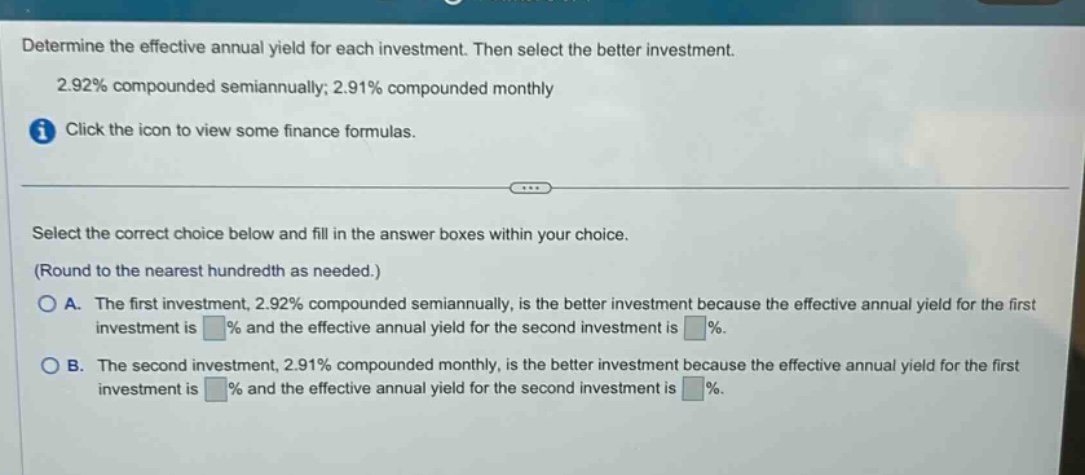
determine the effective annual yield for each investment. then select the better investment. 2.92% compounded semiannually; 2.91% compounded monthly click the icon to view some finance formulas. select the correct choice below and fill in the answer boxes within your choice. (round to the nearest hundredth as needed.) a. the first investment, 2.92% compounded semiannually, is the better investment because the effective annual yield for the first investment is % and the effective annual yield for the second investment is %. b. the second investment, 2.91% compounded monthly, is the better investment because the effective annual yield for the first investment is % and the effective annual yield for the second investment is %.
Answer
Explanation:
Step1: Recall effective - annual - yield formula
The formula for the effective - annual - yield (EAR) is $EAR=(1 + \frac{r}{n})^{n}-1$, where $r$ is the annual interest rate and $n$ is the number of compounding periods per year.
Step2: Calculate EAR for 2.92% compounded semiannually
For the first investment, $r = 0.0292$ and $n = 2$. $EAR_1=(1+\frac{0.0292}{2})^{2}-1=(1 + 0.0146)^{2}-1=1.0146^{2}-1=1.02941316 - 1=0.02941316\approx 2.94%$
Step3: Calculate EAR for 2.91% compounded monthly
For the second investment, $r = 0.0291$ and $n = 12$. $EAR_2=(1+\frac{0.0291}{12})^{12}-1$. Let $x=\frac{0.0291}{12}=0.002425$. Then $(1 + x)^{12}=1 + 12x+\frac{12\times11}{2!}x^{2}+\cdots+x^{12}$. Using the formula $(1 + x)^{n}=\sum_{k = 0}^{n}\binom{n}{k}x^{k}$, or simply calculating $(1+0.002425)^{12}\approx1.029457 - 1=0.029457\approx 2.95%$
Step4: Compare the effective - annual - yields
Since $2.94%<2.95%$, the second investment is better.
Answer:
B. The second investment, 2.91% compounded monthly, is the better investment because the effective annual yield for the first investment is 2.94% and the effective annual yield for the second investment is 2.95%.