8. (ee.3) mr sheffield earns $2,680 per month after taxes. he budgets 3/10 of his income for his mortgage…
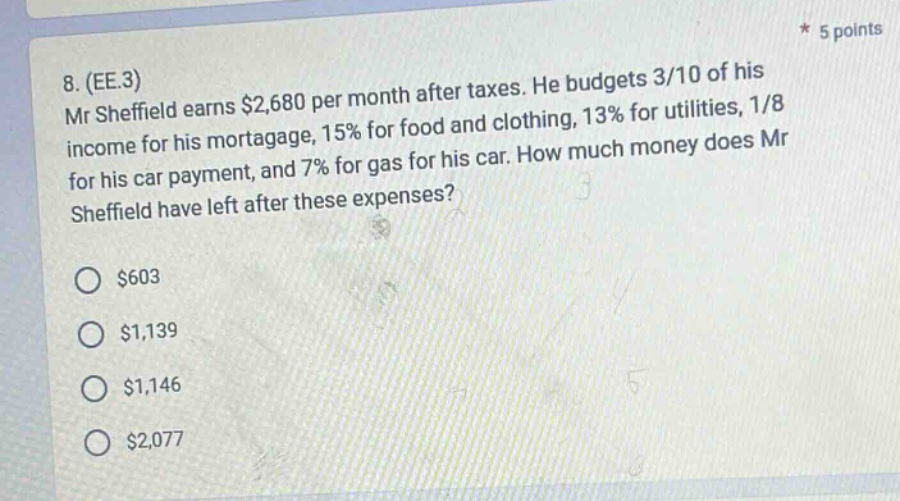
8. (ee.3) mr sheffield earns $2,680 per month after taxes. he budgets 3/10 of his income for his mortgage, 15% for food and clothing, 13% for utilities, 1/8 for his car payment, and 7% for gas for his car. how much money does mr sheffield have left after these expenses? $603 $1,139 $1,146 $2,077
Answer
Explanation:
Step1: Convert percentages to fractions
15% = $\frac{15}{100}=\frac{3}{20}$, 13% = $\frac{13}{100}$, 7% = $\frac{7}{100}$.
Step2: Calculate the total fraction of income spent
The fraction for mortgage is $\frac{3}{10}$, for car - payment is $\frac{1}{8}$, for food and clothing is $\frac{3}{20}$, for utilities is $\frac{13}{100}$, and for gas is $\frac{7}{100}$. First, find a common denominator. The least - common multiple of 10, 8, 20, 100 is 200. $\frac{3}{10}=\frac{3\times20}{10\times20}=\frac{60}{200}$, $\frac{1}{8}=\frac{1\times25}{8\times25}=\frac{25}{200}$, $\frac{3}{20}=\frac{3\times10}{20\times10}=\frac{30}{200}$, $\frac{13}{100}=\frac{13\times2}{100\times2}=\frac{26}{200}$, $\frac{7}{100}=\frac{7\times2}{100\times2}=\frac{14}{200}$. The total fraction of income spent is $\frac{60 + 25+30 + 26+14}{200}=\frac{155}{200}=\frac{31}{40}$.
Step3: Calculate the fraction of income left
The fraction of income left is $1-\frac{31}{40}=\frac{40 - 31}{40}=\frac{9}{40}$.
Step4: Calculate the amount of money left
Mr. Sheffield's income is $2680. The amount of money left is $\frac{9}{40}\times2680$. $\frac{9}{40}\times2680 = 9\times67=603$.
Answer:
$603