an emergency fund is defined as a savings account that has a balance equal to at least two months living…
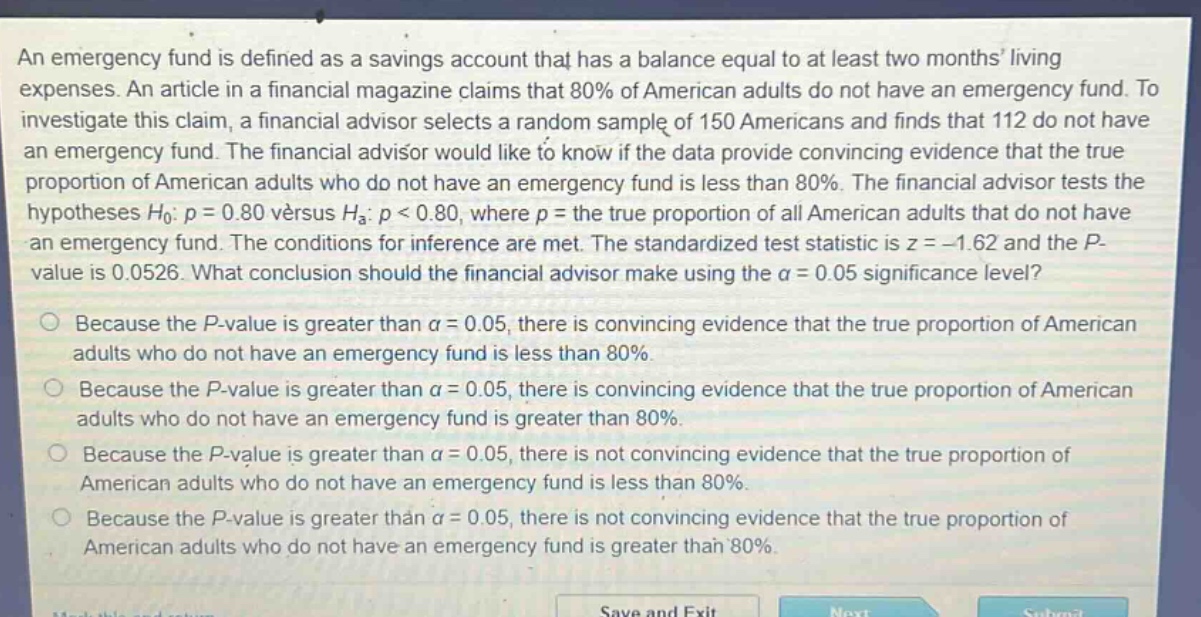
an emergency fund is defined as a savings account that has a balance equal to at least two months living expenses. an article in a financial magazine claims that 80% of american adults do not have an emergency fund. to investigate this claim, a financial advisor selects a random sample of 150 americans and finds that 112 do not have an emergency fund. the financial advisor would like to know if the data provide convincing evidence that the true proportion of american adults who do not have an emergency fund is less than 80%. the financial advisor tests the hypotheses h0: p = 0.80 versus ha: p < 0.80, where p = the true proportion of all american adults that do not have an emergency fund. the conditions for inference are met. the standardized test statistic is z = -1.62 and the p - value is 0.0526. what conclusion should the financial advisor make using the α = 0.05 significance level? because the p - value is greater than α = 0.05, there is convincing evidence that the true proportion of american adults who do not have an emergency fund is less than 80%. because the p - value is greater than α = 0.05, there is convincing evidence that the true proportion of american adults who do not have an emergency fund is greater than 80%. because the p - value is greater than α = 0.05, there is not convincing evidence that the true proportion of american adults who do not have an emergency fund is less than 80%. because the p - value is greater than α = 0.05, there is not convincing evidence that the true proportion of american adults who do not have an emergency fund is greater than 80%.
Answer
Explanation:
Step1: Recall decision - rule for hypothesis testing
In hypothesis testing, if the P - value is greater than the significance level $\alpha$, we fail to reject the null hypothesis $H_0$.
Step2: Compare P - value and $\alpha$
We are given that $\alpha=0.05$ and the P - value is $0.0526$. Since $0.0526>0.05$.
Step3: Make conclusion about the null hypothesis
Since the P - value is greater than $\alpha$, we fail to reject the null hypothesis $H_0:p = 0.80$. This means there is not convincing evidence that the true proportion of American adults who do not have an emergency fund is less than 80%.
Answer:
Because the P - value is greater than $\alpha = 0.05$, there is not convincing evidence that the true proportion of American adults who do not have an emergency fund is less than 80%.