7. an employee put $5,000.00 in a retirement account that offers 9% interest compounded annually. the…
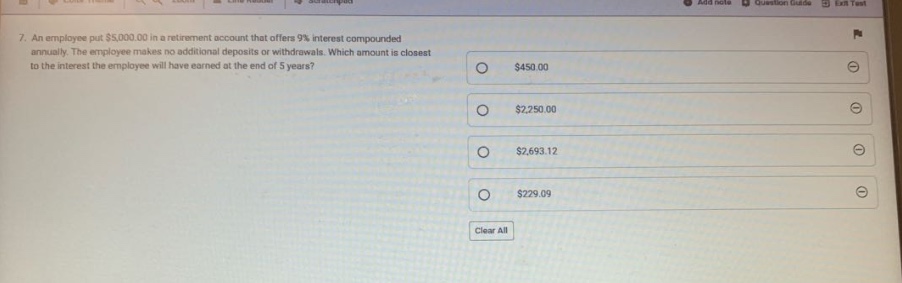
7. an employee put $5,000.00 in a retirement account that offers 9% interest compounded annually. the employee makes no additional deposits or withdrawals. which amount is closest to the interest the employee will have earned at the end of 5 years? $450.00 $2,250.00 $2,693.12 $229.09 clear all
Answer
Explanation:
Step1: Recall compound - interest formula
The compound - interest formula is $A = P(1 + r)^t$, where $P$ is the principal amount, $r$ is the annual interest rate (in decimal form), and $t$ is the number of years. The interest earned $I=A - P$. Here, $P = 5000$, $r=0.09$, and $t = 5$.
Step2: Calculate the amount $A$
First, calculate $A$ using the formula $A=P(1 + r)^t$. Substitute the values: $A = 5000\times(1 + 0.09)^5=5000\times(1.09)^5$. $(1.09)^5=1.09\times1.09\times1.09\times1.09\times1.09\approx1.538624$. Then $A = 5000\times1.538624 = 7693.12$.
Step3: Calculate the interest $I$
The interest earned $I=A - P$. Substitute $A = 7693.12$ and $P = 5000$ into the formula. $I=7693.12−5000 = 2693.12$.
Answer:
$2,693.12$