an employee put $4,000 in a retirement account that offers 9.2% interest compounded annually. if the…
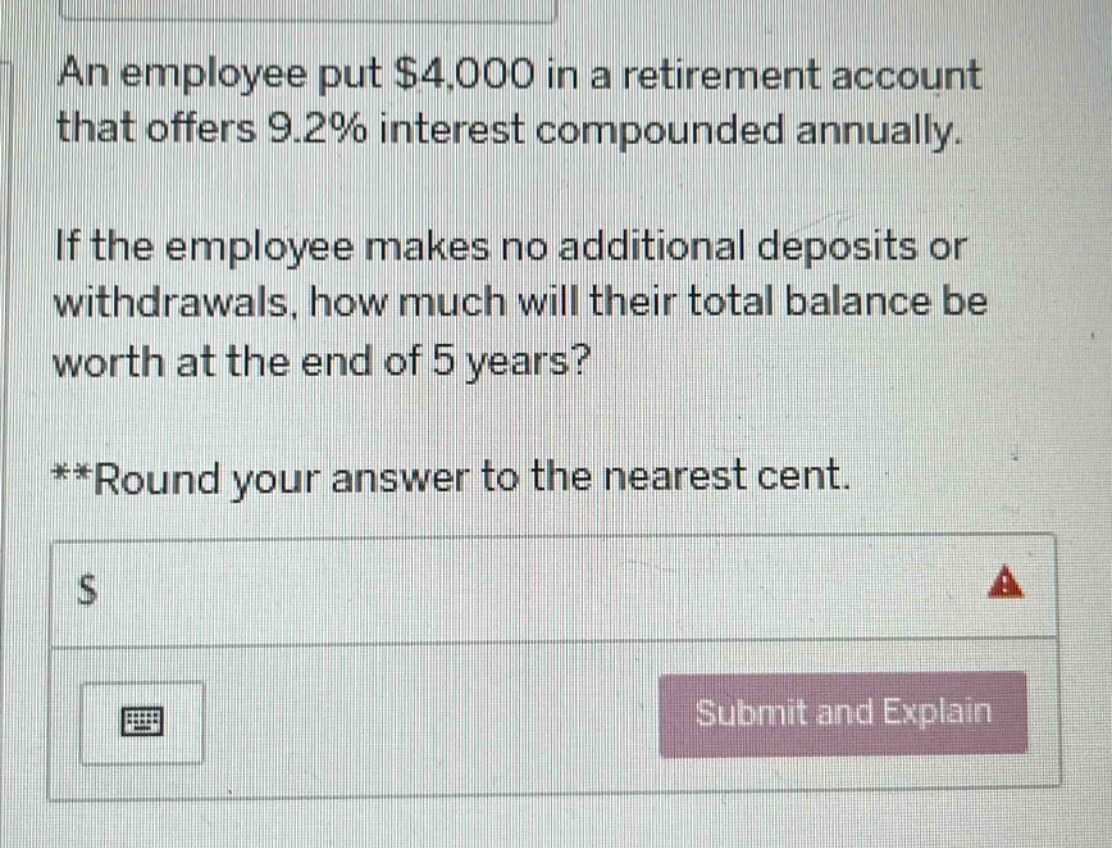
an employee put $4,000 in a retirement account that offers 9.2% interest compounded annually. if the employee makes no additional deposits or withdrawals, how much will their total balance be worth at the end of 5 years? **round your answer to the nearest cent.
Answer
Explanation:
Step1: Identify compound - interest formula
The compound - interest formula is $A = P(1 + r)^t$, where $A$ is the final amount, $P$ is the principal amount, $r$ is the annual interest rate (in decimal form), and $t$ is the number of years.
Step2: Convert the interest rate to decimal
Given $r = 9.2%=0.092$, $P = 4000$, and $t = 5$.
Step3: Substitute values into the formula
$A=4000\times(1 + 0.092)^5$. First, calculate $(1 + 0.092)^5=(1.092)^5$. $(1.092)^5=1.092\times1.092\times1.092\times1.092\times1.092\approx1.55377$. Then, $A = 4000\times1.55377 = 6215.08$.
Answer:
$6215.08$