the equations for two savings accounts for the same initial amount of $925 and an interest rate of .75%…
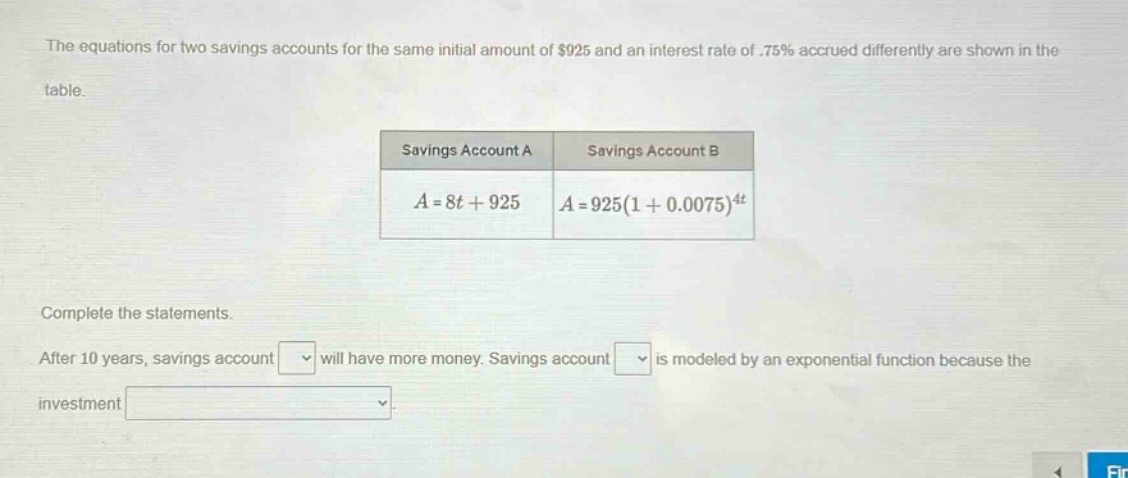
the equations for two savings accounts for the same initial amount of $925 and an interest rate of .75% accrued differently are shown in the table. savings account a savings account b a = 8t + 925 a = 925(1 + 0.0075)^4t complete the statements. after 10 years, savings account will have more money. savings account is modeled by an exponential function because the investment
Answer
Explanation:
Step1: Calculer le montant de Compte A après 10 ans
On remplace $t = 10$ dans l'équation $A = 8t+925$. $A_A=8\times10 + 925=80 + 925=1005$
Step2: Calculer le montant de Compte B après 10 ans
On remplace $t = 10$ dans l'équation $A = 925(1 + 0.0075)^{4t}$. $A_B=925(1 + 0.0075)^{4\times10}=925(1.0075)^{40}$. $(1.0075)^{40}\approx1.34835$ (en utilisant une calculatrice scientifique). $A_B=925\times1.34835\approx1247.22$
Step3: Comparer les deux montants
Puisque $1247.22>1005$, le compte B a plus d'argent après 10 ans. Le compte B est une fonction exponentielle car l'investissement est soumis à un intérêt composé (le capital initial est multiplié par un facteur $(1 + r)^n$ où $r$ est le taux d'intérêt et $n$ est le nombre de périodes de capitalisation).
Answer:
Après 10 ans, le compte d'épargne B aura plus d'argent. Le compte d'épargne B est modélisé par une fonction exponentielle car l'investissement est soumis à un intérêt composé.