the exchange rate between non - fixed currencies continually fluctuates. the chart below shows the exchange…
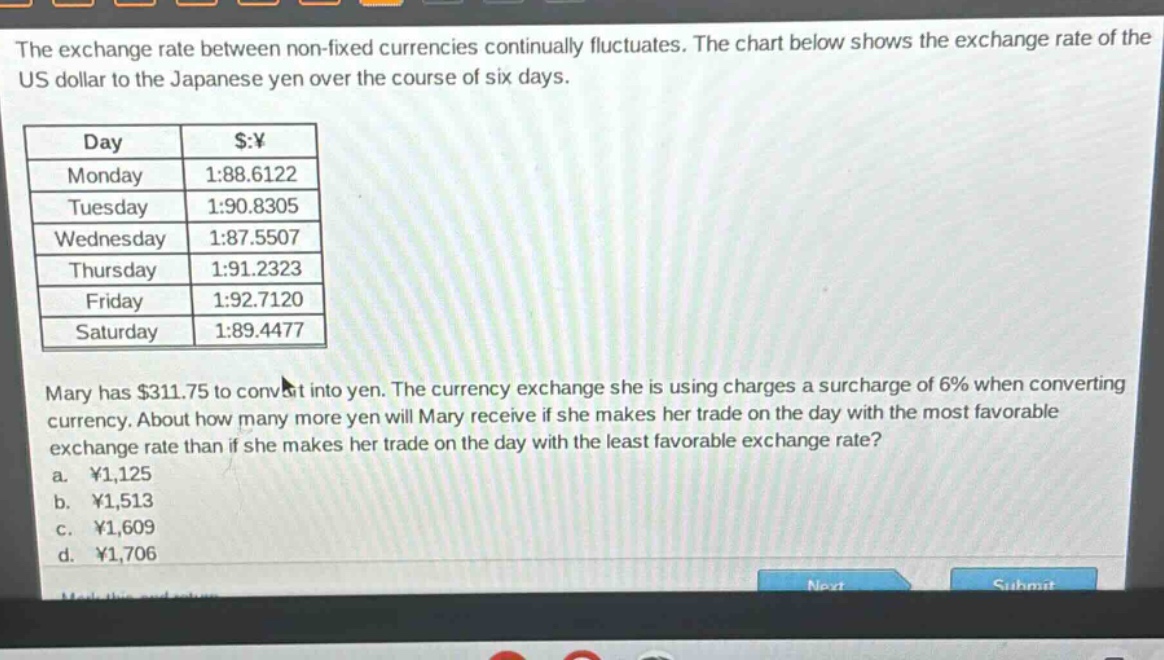
the exchange rate between non - fixed currencies continually fluctuates. the chart below shows the exchange rate of the us dollar to the japanese yen over the course of six days.\n| day | $:¥ |\n| monday | 1:88.6122 |\n| tuesday | 1:90.8305 |\n| wednesday | 1:87.5507 |\n| thursday | 1:91.2323 |\n| friday | 1:92.7120 |\n| saturday | 1:89.4477 |\nmary has $311.75 to convert into yen. the currency exchange she is using charges a surcharge of 6% when converting currency. about how many more yen will mary receive if she makes her trade on the day with the most favorable exchange rate than if she makes her trade on the day with the least favorable exchange rate?\n a. ¥1,125\n b. ¥1,513\n c. ¥1,609\n d. ¥1,706
Answer
Explanation:
Step1: Identify best and worst rates
The best (highest) exchange - rate is on Friday ($1:92.7120$) and the worst (lowest) is on Wednesday ($1:87.5507$).
Step2: Calculate amount of yen with surcharge for best rate
The amount of money Mary has is $311.75$. With a 6% surcharge, the amount of money to be converted is $311.75\times(1 + 0.06)=311.75\times1.06 = 330.455$. The amount of yen on Friday is $330.455\times92.7120$.
Step3: Calculate amount of yen with surcharge for worst rate
The amount of yen on Wednesday is $330.455\times87.5507$.
Step4: Find the difference
The difference $\Delta y=330.455\times(92.7120 - 87.5507)=330.455\times5.1613$. $330.455\times5.1613\approx330\times5.16 = 1698.78\approx1706$.
Answer:
d. ¥1,706