flip opened a credit card account. during the first month he purchased new cloths that totaled $1,535.5 and…
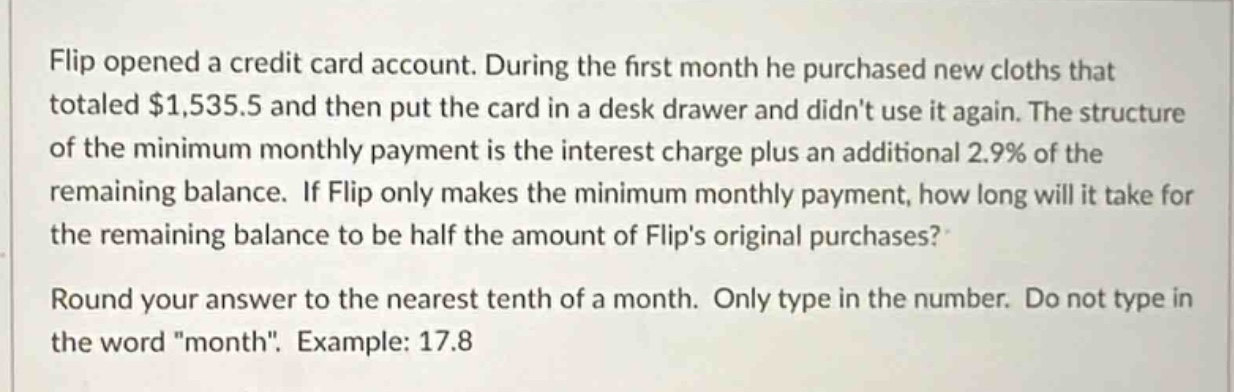
flip opened a credit card account. during the first month he purchased new cloths that totaled $1,535.5 and then put the card in a desk drawer and didnt use it again. the structure of the minimum monthly payment is the interest charge plus an additional 2.9% of the remaining balance. if flip only makes the minimum monthly payment, how long will it take for the remaining balance to be half the amount of flips original purchases?\nround your answer to the nearest tenth of a month. only type in the number. do not type in the word \month\. example: 17.8
Answer
Explanation:
Step1: Define the variables
Let the initial balance $P = 1535.5$, the target balance $A=\frac{1535.5}{2}=767.75$, and the monthly - payment rate $r = 0.029$. The balance after the first month $B_1=P(1 - r)$. After $n$ months, the balance $B_n=P(1 - r)^n$.
Step2: Set up the equation
We want to find $n$ such that $B_n = A$. Substituting the values of $A$ and $P$ into the formula $B_n=P(1 - r)^n$, we get $767.75 = 1535.5(1 - 0.029)^n$.
Step3: Simplify the equation
Divide both sides of the equation by $1535.5$: $\frac{767.75}{1535.5}=(0.971)^n$. Since $\frac{767.75}{1535.5}=0.5$, the equation becomes $0.5=(0.971)^n$.
Step4: Take the natural - logarithm of both sides
$\ln(0.5)=n\ln(0.971)$.
Step5: Solve for $n$
$n=\frac{\ln(0.5)}{\ln(0.971)}$. Using a calculator, $\ln(0.5)\approx - 0.6931$ and $\ln(0.971)\approx-0.0294$. Then $n=\frac{- 0.6931}{-0.0294}\approx23.6$.
Answer:
23.6