gareth has $2,000 to invest. putting the money in a savings account at his local bank will earn him 2.2%…
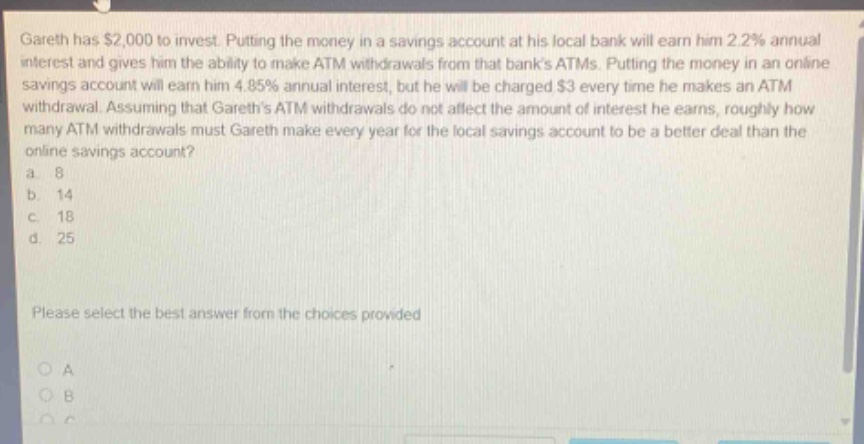
gareth has $2,000 to invest. putting the money in a savings account at his local bank will earn him 2.2% annual interest and gives him the ability to make atm withdrawals from that banks atms. putting the money in an online savings account will earn him 4.85% annual interest, but he will be charged $3 every time he makes an atm withdrawal. assuming that gareths atm withdrawals do not affect the amount of interest he earns, roughly how many atm withdrawals must gareth make every year for the local savings account to be a better deal than the online savings account? a. 8 b. 14 c. 18 d. 25 please select the best answer from the choices provided
Answer
Explanation:
Step1: Calculate local bank interest
The interest from the local bank is calculated using the simple - interest formula $I = Prt$. Here, $P=$2000$, $r = 0.022$ and $t = 1$. So the interest $I_{local}=2000\times0.022=$44$.
Step2: Calculate online bank interest and fees
The interest from the online bank is $I_{online}=2000\times0.0485=$97$. Let the number of ATM withdrawals be $n$. The total cost for online bank with withdrawals is $C = 97-3n$.
Step3: Set up inequality
We want to find when the local bank is a better deal, so we set up the inequality $44>97 - 3n$.
Step4: Solve the inequality
First, add $3n$ to both sides: $44 + 3n>97$. Then subtract 44 from both sides: $3n>97 - 44$, so $3n>53$. Divide both sides by 3: $n>\frac{53}{3}\approx17.67$.
Answer:
C. 18