hal has just graduated from four years of college. for the last two years, he took out a stafford loan to…
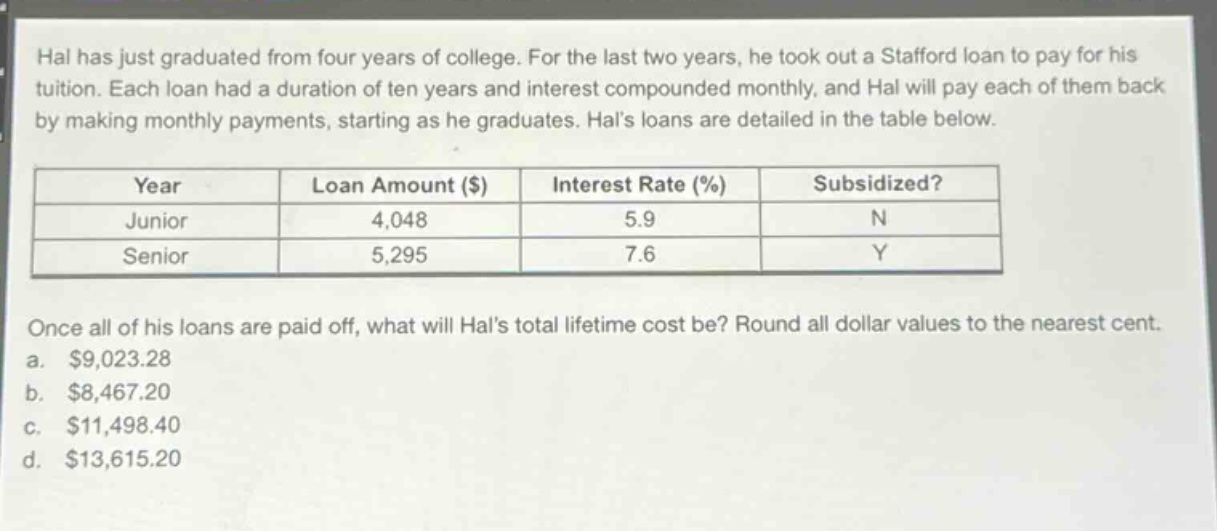
hal has just graduated from four years of college. for the last two years, he took out a stafford loan to pay for his tuition. each loan had a duration of ten years and interest compounded monthly, and hal will pay each of them back by making monthly payments, starting as he graduates. hals loans are detailed in the table below.\n| year | loan amount ($) | interest rate (%) | subsidized? |\n| ---- | ---- | ---- | ---- |\n| junior | 4,048 | 5.9 | n |\n| senior | 5,295 | 7.6 | y |\nonce all of his loans are paid off, what will hals total lifetime cost be? round all dollar values to the nearest cent.\na. $9,023.28\nb. $8,467.20\nc. $11,498.40\nd. $13,615.20
Answer
Answer:
d. $$13,615.20$
Explanation:
Step1: Calculate monthly - payment formula for non - subsidized loan
The formula for the monthly payment of a loan is $M = P\frac{r(1 + r)^n}{(1 + r)^n-1}$, where $P$ is the principal amount, $r$ is the monthly interest rate, and $n$ is the total number of payments. For the junior - year non - subsidized loan: $P_1=4048$, the annual interest rate $i_1 = 5.9%=0.059$, so the monthly interest rate $r_1=\frac{0.059}{12}$, and the number of payments $n = 10\times12 = 120$. $r_1=\frac{0.059}{12}\approx0.004917$ $M_1 = 4048\frac{0.004917(1 + 0.004917)^{120}}{(1 + 0.004917)^{120}-1}$ $(1 + 0.004917)^{120}\approx1.8193$ $M_1 = 4048\frac{0.004917\times1.8193}{1.8193 - 1}=4048\frac{0.00896}{0.8193}\approx44.17$ The total cost of the junior - year loan $C_1 = M_1\times120=44.17\times120 = 5300.4$
Step2: Calculate monthly - payment formula for subsidized loan
For the senior - year subsidized loan: $P_2 = 5295$, the annual interest rate $i_2=7.6% = 0.076$, so the monthly interest rate $r_2=\frac{0.076}{12}\approx0.006333$, and $n = 120$. $M_2 = 5295\frac{0.006333(1 + 0.006333)^{120}}{(1 + 0.006333)^{120}-1}$ $(1 + 0.006333)^{120}\approx2.117$ $M_2 = 5295\frac{0.006333\times2.117}{2.117 - 1}=5295\frac{0.013417}{1.117}\approx63.46$ The total cost of the senior - year loan $C_2 = M_2\times120=63.46\times120 = 7615.2$
Step3: Calculate total lifetime cost
The total lifetime cost $C = C_1 + C_2=5300.4+7615.2 = 13615.6\approx13615.20$ (after rounding to the nearest cent)