hans deposited $4000 into an account with a 2.3% annual interest rate, compounded semiannually. assuming…
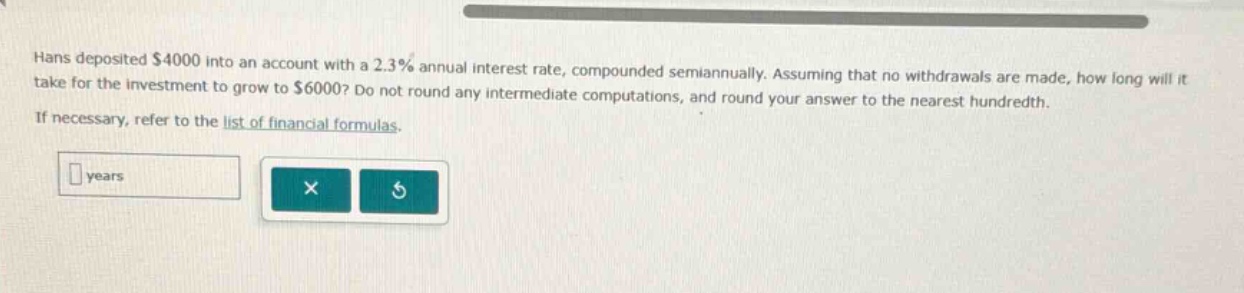
hans deposited $4000 into an account with a 2.3% annual interest rate, compounded semiannually. assuming that no withdrawals are made, how long will it take for the investment to grow to $6000? do not round any intermediate computations, and round your answer to the nearest hundredth. if necessary, refer to the list of financial formulas.
Answer
Answer:
$18.14$
Explanation:
Step1: Identify compound - interest formula
The compound - interest formula is $A = P(1+\frac{r}{n})^{nt}$, where $A$ is the final amount, $P$ is the principal amount, $r$ is the annual interest rate (in decimal form), $n$ is the number of times interest is compounded per year, and $t$ is the number of years. Given $P = 4000$, $A=6000$, $r = 0.023$, and $n = 2$ (compounded semiannually). Substitute these values into the formula: $6000=4000(1 +\frac{0.023}{2})^{2t}$.
Step2: Simplify the equation
First, divide both sides of the equation by $4000$: $\frac{6000}{4000}=(1 + 0.0115)^{2t}$, which simplifies to $1.5=(1.0115)^{2t}$.
Step3: Take the natural logarithm of both sides
$\ln(1.5)=\ln((1.0115)^{2t})$. Using the property of logarithms $\ln(a^{b})=b\ln(a)$, we get $\ln(1.5)=2t\ln(1.0115)$.
Step4: Solve for $t$
First, find $\ln(1.5)\approx0.4055$ and $\ln(1.0115)\approx0.0114$. Then, $t=\frac{\ln(1.5)}{2\ln(1.0115)}$. $2\ln(1.0115)=2\times0.0114 = 0.0228$. $t=\frac{0.4055}{0.0228}\approx18.14$.